This is part two of a series. Read part one here. Part three, here.
In my previous post I argued that a 40 day preparatory period leading up to Easter is a very ancient Christian practice, as old as the Nicene Creed or the first complete articulation of the New Testament canon (4th c.). I also argued that fasting has always been a part of the Christian Church’s preparation for Easter, going at least as far back as the early third century. To make this argument I referenced several primary sources, including one well respected Christian Father, St. Athanasius of Alexandria.
The primary question that arises out of that post is, “What kind of fasting was involved in those early days?” and a consequent question is, “How should I fast during Lent?” This post is an attempt to begin to answer both of those questions.
The short answer is that these early sources do not tell us much about exactly how the fast was kept. In his second festal letter of 330 AD, St. Athanasius’ does not give any directions as to what is to be fasted from or how the fast is to be kept, only that it be kept. The reason for this seems to be that there was a great deal of local control over the nature of the fast, and that it was up to the local pastor (bishop) to set the parameters according to his own cultural situation and pastoral wisdom. Thomas J. Talley, in his book The Origins of the Liturgical Year, presents evidence that early Lenten fasting practices varied widely. By this he means that there was variation both in the number of actual fast days (for there was never a continuous 40 day fast. Sundays were always exempted and Saturdays were also in most places) and in the manner of fasting.
It seems clear that the most arduous form of fasting would be abstinence from all meat and dairy. Additionally, from the sixth century we find that monks were allowed to eat one meal a day during the fast. What this says about the laity and their practices is unclear, but it seems likely that their fast would have been less arduous. In addition there were periods of Lent were a less arduous fast was prescribed: some allowing for the eating of diary products and eggs for a portion of the fast.
Talley concludes at the end of the book that though the bulk of our detail concerning Lenten fasting comes from monastic sources, the laity still participated in the observance of Lent in some way. For the laity, Lent was primarily about penitence, a season to especially be mindful of and to repent of one’s sins. What fasting the laity observed is not clear, though it seems, as I mentioned above, that it was locally prescribed by local pastors and bishops, and that it must have been less arduous than that which was prescribed for monks.
Later in Church history Lenten practices become a bit clearer and more uniform. The practice that came into being was to take one meal a day during Lent, abstaining from meat, milk, and eggs (excluding Sundays). Yet how late this general practice came to be is not clear. As I mentioned above, most of the information we have is from monastic sources. Furthermore there were many local dispensations that kept the actual fasting from being so severe. Additionally, certain trades and people in certain conditions (ill, pregnant, young or old of age) were exempted. The fact of the matter is that with all the dispensations, Lenten fasting has always been something where a general ideal was applied to local and individual circumstances.
So we return to our original question, “What kind of fast was instituted in the early Church?” The answer is that it was locally variable and individually applicable. Pastors worked with the laity to ensure that some appropriate form of fasting or abstinence was taking place. Monks performed the most arduous fasts, but the laity surely did not follow with the same rigor.
This leads us, in closing, to the second question, which is, “How then should I fast?” The answer is that this is something best left up to individual pastors and churches to decide. Even in the Presbyterian tradition, the elders of the church have the authority to call a fast. The Westminster Confession of Faith 21-5 says that “solemn fastings,” are a part of the true religious worship of God. Furthermore, chapter 62 of the PCA’s Book of Church Order provides for individual churches, presbyteries, and the entire denomination to call for a fast. That chapter even allows for the church to keep a fast called for by civil authorities if the leaders of the church find it in keeping with the Christian faith. There is certainly nothing keeping any individual church or presbytery from calling a fast for Lent. It would be completely in accord with the constitution of our church.
In conclusion, we know that Lenten fasting is very ancient, and we know that the details of the fast have always (to greater and lesser degrees) been left to local churches. Therefore it seems that it would be good practice for our churches to consider ways in which we might begin incorporating Lenten fasting. This is one way in which we can keep step with the broader church and more fully express our unity with her. I wonder if we might heed the admonition of St. Athanasius, a Father of the Church that we hold in high regard:
Persuade them to fast; to the end that we who are in Egypt should not become a laughing-stock, as the only people who do not fast, but take our pleasure in these days.
We in Reformed circles are reticent to fast because we see it as a medieval catholic practice. Yet the historical sources show us that it is far more ancient. These same sources also show that local churches have always had the ability to set the parameters of the fast.
Therefore, let us keep the fast in order that we may keep the feast!
This is part two of a series. Read part one here. Part three, here.
But those who are in his body appropriately eat the body, in order that while he is on the journey, through the body of Christ alone he might be refreshed by his flesh and learn not to hunger for anything but Christ, to thirst for nothing but Christ, to taste nothing but Christ, to live by none other, nor to be anything other than the body of Christ.
This is part one of a series. Part two can be read here. Part three, here.
Every year as the season of Lent begins there are a variety of essays, articles, posts, and tweets about Lent and its observance. This season may be foreign to many people, whether they are Christians or not, so there are inevitably questions about what this season is and what it is for. If you are looking to learn more about the season of Lent, especially how it originated, you came to the right place.
Additionally, In the world I inhabit there are annual conversations about whether Lent should or shouldn’t be practiced since it is a Roman Catholic invention and Reformed Protestants should not engage in Roman Catholic practices. The problem with this line of thinking is that Lent is not a Roman Catholic invention. Lent is an ancient Christian practice whose roots trace back as far as we have historical evidence to trace them. Thus, rejecting Lent due to its associations with Roman Catholicism is faulty reasoning.
This post is a part of these ongoing discussions. In it I want to give some foundational information about the origins of Lent and also to put forth a certain argument for the practice of Lent by way of exploring its history. As I am a credentialed historical theologian, this historical theological exploration is both my specialty and my passion. Therefore in this post I would like to answer one question: What are the historical origins of Lent: how far back does the observance of Lent go, and what, if anything, can we say about ancient Lenten practices?
Lenten Origins Found in Holy Week
The origins of the season of Lent go as far back as the mid second century. While the 40 day penitential season cannot be traced further back than the early 4th c., that season developed from earlier, shorter, preparatory fasts that preceded Easter. In several sources, including the Didascalia Apostolorum, The Apostolic Tradition, and a Festal Letter by Dionysius of Alexandria, we find that there was a one, two, or six day preparatory fast leading up to Easter, depending on the time and location. This places the practice of preparatory fasting as early as the first half of the third century (200-250 AD). If these sources mention those seasons as established practices, then it seems safe to say that the origins of these practices would stretch further into the latter half of the second century, perhaps even further.
From Holy Week to Quadragesima
By the early 4th century, this six day preparatory fast had become Holy Week and the penitential period was extended to 40 days symbolizing the fasts of Jesus, Moses, and Elijah. We see this in several prominent examples.
The first of these examples is St. Athanasius (c. 297-373 AD). Athanasius is an early church father who is held in high regard by all Christians. There are two main reasons for this respect. First of all, Athanasius is considered to be the champion of Nicene orthodoxy against the early heresy of Arianism, which taught that Jesus was not God but the highest of all created beings. Athanasius was present at the Council of Nicaea (from which we have been bequeathed the ancient and venerable Nicene Creed), and he continued to fight for the orthodox view of the Trinity and the deity of Christ throughout his life, suffering much on account of the faith including two separate exiles from his pastoral see.
The second reason we revere Athanasius is because of his famous 39th Festal Letter written to his parishioners in Alexandria in the year 367. This letter is precious to all Christians because this letter is the first articulation of the entire New Testament canon. This letter should be further appreciated by Protestants because in it he excluded as noncanonical the deuterocanonical books, which are commonly call the Apocrypha. For this reason, Athanasius is known to some as the Father of the Biblical Canon.
While the above two facts are widely known and celebrated, what is not commonly understood is that Athanasius was an ardent promoter of the adoption of the season of Lent. In his 2nd Festal Letter of 330 A.D., some 37 years before the more famous one just mentioned, Athanasius wrote this to his flock:
We begin the fast of forty days on the 13th of the month Phamenoth (Mar. 9). After we have given ourselves to fasting in continued succession, let us begin the holy Paschal week on the 18th of the month Pharmuthi (April 13). Then resting on the 23rd of the same month Pharmuthi (April 18), and keeping the feast afterwards on the first of the week, on the 24th (April 19), let us add to these the seven weeks of the great Pentecost, wholly rejoicing and exulting in Christ Jesus our Lord, through Whom to the Father be glory and dominion in the Holy Ghost, for ever and ever.
Given this evidence, if one was so inclined one might make the argument that the observance of Lent was older than the completion of the biblical canon. While I personally would not go so far as to make this particular argument, I would point out that those who lay claim to Athanasius and his Festal letter as proof for the biblical canon might also take a look at an earlier letter of his that shows his support for keeping the 40 day fast of Lent. The fact that both the fine tuning of the canon and the development of the church year were occurring at the same exact time is notable.
While this quotation is a significant piece of historical evidence, we have to be careful not to overstate its reach. Though this quote reveals to us Athanasius’ desire for a 40 day fast preceding Easter we also find from later letters that this was a change of practice in Alexandria that he was attempting to introduce there. Yet from other sources, including his letter to Bishop Serapion, we find that at least by 340 AD the practice was more widespread. So it seems safe to say that the by the early to mid 4th century, the practice of observing a 40 day fast in preparation for Easter was becoming the norm.
Lent in the Council of Nicaea
The prevalence of Lent by the mid-fourth century is supported by evidence from the Council of Nicaea in 325 A.D. The Council of Nicaea was the first ecumenical council of the church that laid down for all Christians the orthodox doctrine of the Trinity. While the Council did not mandate the observance of Lent, it did acknowledge the existence of a 40 day preparatory liturgical season preceding Easter. In Canon 5 the council decreed that local synods should meet twice a year, “One before Lent (Greek: tessarakosta; Latin: quadragesima; literally: 40 days), so that all pettiness being set aside, the gift offered to God may be unblemished.” This piece of evidence seems significant, because it confirms that Athanasius’ practice was not isolated in 330AD. If the Nicene Fathers referred to Lent in their deliberations, it must have been a pretty widely accepted practice.
Thus, not only was Lent being developed at the same time as the finalizing of the biblical canon, we also find in that era the settling of the doctrine of the Trinity. Note that neither of these pillars, Trinity and Canon, are explicitly mentioned in the Bible. Yet both can be definitively said to be ancient determinations of the church, articulating what the scriptures had already clearly taught. Should the development of the Church Year also fall under that banner, a pillar of Christian practice laid down by the church in the 4th century as an articulation of clear biblical teaching? I would argue so.
Creed, Canon, and Church Year
In conclusion, what are we to take away from this historical evidence? I argue that we should take from it that Lent is a very ancient and universal practice of the Christian Church. Evidence for it is as ancient as evidence for the biblical canon and our most important statement of Trinitarian orthodoxy. Nevertheless, I am not arguing that keeping Lent is as important as the canon of the New Testament or the belief in the Trinity, and neither am I arguing that Lent is as old as these things. This is because Athanasius’ 39th Festal letter is not the origin of the biblical canon. This concept existed far before the year 367 and was held, evidently, by the first Christian disciples of the 1st century. Likewise, neither was the Trinity invented at the council of Nicaea. Trinitarian belief was a part of the Christian faith from it’s earliest days after the resurrection of Jesus. Lent is a 4th century creation. Yet, as we have seen, its roots go back into the second century and, as I have argued elsewhere, the church year itself has clear biblical justification.
Therefore, while the observance of Lent is not as ancient and venerable as the other two of the pillars of our faith it is nevertheless an ancient and respectable practice. Moreover, we see in Athanasius, the most prominent champion of both those pillars, an ardent champion and supporter of the adoption of Lent. If you hold St. Athanasius in high regard, consider this adjuration:
But I have further deemed it highly necessary and very urgent to make known to you that you should proclaim the fast of forty days to the brethren, and persuade them to fast; to the end that, while all the world is fasting, we who are in Egypt should not become a laughing-stock, as the only people who do not fast, but take our pleasure in those days… But, O, our beloved, whether in this way or any other, exhort and teach them to fast forty days. For it is even a disgrace that when all the world does this, those alone who are in Egypt, instead of fasting, should find their pleasure.
This is part one of a series. Part two can be read here. Part three, here.
— Sources: The Origins of the Liturgical Year, by Thomas J. Talley; The Second Festal Letter of Athanasius, accessed here; The 39th Festal Letter of Athanasius, accessed here; Athanasius’ April 340 letter to Serapion found in Les lettres festales de saint Athanase, edited by L. Lefort, pp 654-656; The Canons of the Council of Nicaea, in Decrees of the Ecumenical Councils by Norman P. Tanner.

In Luke 4:18 Jesus claims that he has been anointed a Messianic Prophet:
“The Spirit of the Lord is upon me, because he has anointed me to proclaim good news to the poor. He has sent me to proclaim liberty to the captives and recovering of sight to the blind, to set at liberty those who are oppressed, (Luke 4:18 ESV)
What does it mean to be anointed, and why was Jesus anointed? Well, both the Greek and Hebrew words used in the Bible for anointing literally mean “to smear oil on something.” Yet the question arises, what does smearing oil on something have to do with preparing one for ministry? In the Bible we know that priests, kings, and prophets were all anointed. What is it about rubbing or smearing oil on someone that is beneficial for these tasks?
If we study ancient near eastern bathing practices we find that oil had a prominent place in bathing. Oil was used like we use soap, to aid the water in the cleaning process. Also, oil was used after the bath in order to protect the skin against the harsh arid climates surrounding the Mediterranean. We see evidence for this in the Bible in 2 Sam. 12:20. Therefore we see that oil aides the water and oil protects the body.
What else does oil do? We also find in the Scriptures in Psalm 104:15 that oil makes the face shine. Shining faces speak of glory. When Moses went in to speak with God, he had a shining face. So rubbing oil on the head and face makes one glorious.
What else? We also find in the Scriptures and in other ancient sources that the weapons of warriors, and even the warriors themselves would be anointed with oil for battle. The purpose is unclear, but it seems to have served a protective purpose. Thus we see that anointing is for cleansing and protection, to aid in battle, and to give one a glorious shine.
Yet Jesus stands up in the synagogue and says: “The Spirit of the Lord has anointed me.” Now this removes the physical oil completely from the equation and reduces the anointing to its spiritual significance. Yet we must not forget what an anointing with oil does: it cleanses, it protects, it makes ready for battle, and it glorifies. Here we see that the spiritual reality of an anointing is the pouring out of the Holy Spirit. Specifically, this anointing which Jesus is proclaiming about himself occurred at his baptism, where he was washed with water, and the oil of the Spirit aided the baptism and was applied to Jesus in conjunction with the water. After His baptism, Jesus is now the Messiah, the Anointed One, and he is cleansed, protected, glorified, and made ready for his new ministry (battle) that is before him.
Maybe you bristled just now when I said that Jesus was cleansed by his baptism and his anointing. “Wait a second,” you say, “ wasn’t Jesus perfectly sinless? Why then did he need to be cleansed?” Well, I agree that Jesus was perfectly sinless. Yet he was made incarnate into our own fallen human flesh. It wasn’t his own sin for which he needed to be cleansed, but for the sins of all of us. Jesus was baptized for us so that we could follow him through the waters of baptism into the new creation that he is bringing into the world. The cleansing of his baptism and anointing, therefore, cleansed our fallen humanity and readied it to be able to “pass through the heavens,” (Heb. 4:14) to sit at the right hand of God as the Ruler and Judge of the entire cosmos.
This Sunday, December 2, 2012 is the first Sunday of the new church year and the first Sunday in Advent.
But what is Advent and why should I as a Christian be concerned with observing Advent?
This question goes a bit deeper into questions of observing the church year in general. Should Christians be concerned with observing special dates and festivals during the cycle of the year?
I would argue, yes. There are many reasons in favor of observing the church year, but let’s consider just one of those briefly. Just reflect for a moment on our civil calendar. Every year we have a cycle that affects our lives, our decisions, when we travel, when we shop, what we eat, and more – based on the civil calendar of the United States of America. This calendar is designed to make us good citizens and remind us of the major milestones of our national history. It shapes and forms our hearts and minds. The US civil calendar disciples us. It makes us into good little American disciples.
Now, there is some value in this, and I’m not against having a civil calendar, but we are being completely naive if we think that this worldly calendar doesn’t need to have the necessary counterbalance that the church calendar provides us. The civil calendar teaches us to honor and remember, but it also breeds in us a nationalistic zeal that makes us myopic with regard to the world around us. We have to understand that if we shun the church calendar, the only calendar we will have is the civil calendar, and it will be the only annual rhythmic influence on our lives and on our children’s lives. That’s very significant to consider.
Seen in this way, the church year provides a balance to the messages we receive from the calendars that this world provides. In the church calendar, each year we are taught to hope for justice and long for the coming of a Savior (Advent), to celebrate that Savior’s incarnation as God in our own flesh (Christmas), to bask in the glow of the light that the Son of God shines in our dark world (Epiphany), to mourn our own contributions to this world’s brokenness and darkness and the fact that the Son of God had to die to fix it (Lent), to rejoice in the great victory that Jesus Christ won on the cross and the vindication of Him by His Father when He raised Him from the dead (Easter), to celebrate that this man Jesus is now glorified and ascended to heaven and now rules all the entire universe (Ascension), to ponder anew the great power and dignity that he has bestowed on us by sending His Holy Spirit to fill us and empower us (Pentecost), and to take up the mantle as the Church Militant to extend the glorious reign of Christ to all the reaches of the Earth (Trinity Season). Each year this pattern forms Christians and shapes them into Christian disciples.
We need this counter-formation. We as Christians cannot keep our heads in the sand and pretend that we don’t need a Christian calendar to provide balance to the worldly calendars all around us. If we do not offer a counter-formation to the liturgies of the world, then we as the church will be producing disciples that are no different from those in the world around us. We will be self-centered, greedy, entertainment hungry, individualistic, sex crazed, bloodthirsty robots. And isn’t this who we are already? Aren’t these the kinds of disciples our churches are already churning out? Is this what we want to be like? What we want our children to be like?
Now, I’m not advocating that we should remove ourselves from the world, far from it! We as Christians need to be engaged in the world and in the culture so that we can have a voice to its direction and so that we can relate to our friends and neighbors as we share Christ’s love with them. And neither am I claiming that celebrating the church year is some kind of panacea that will cure all our ills and make us all perfect little Christian disciples. Yet, we must see that the calendar of this world is affecting us, and that we desperately need a counterbalance and counter-formation to the formation that the world provides. The church year is not religious formalism. It is not dead religiosity. No, when conceived of properly and with the proper pastoral leadership, observation of the church year can provide an antidote to the poisons that this world delivers to us and which we greedily lap up every single day.
You see, the church calendar provides a disposition. It provides an outlook, a worldview. It gives us something to carry us over from Sunday to Sunday and even to look ahead to weeks and months in the future. It gives us good gospel themes to consider and good godly disciplines to practice. The church calendar makes us wait, watch, pray, and long before we dive headlong into the celebrations of the great feasts of Christmas and Easter. We must long for the coming of Christ and have instilled in us a deep frustration and desire that he would come before we revel in the joys of Christmas morning. It makes us consider the deep hurts and brokenness of this world and long for their restitution before we celebrate the victory that will lead to their banishment.
And this, in short, is the reason for Advent. Celebrating Christmas without advent is what theologians call having an over-realized eschatology: celebrating the victory of Jesus Christ (which is very true and real) without also mourning the fact that in many ways it is not yet reached its consummation. Celebrating Christmas without Advent is like skipping your vegetables and jumping straight for the luxurious chocolate cake or the sumptuous apple pie à la mode. Dessert is wonderful, and something that should be a part of our lives, but if we skip the vegetables and go right to the dessert we will be fat and malnourished.
That’s where we are as American Christians. We are fat and malnourished. We need to eat our vegetables. We need the expectation and patient longing of Advent before we dive headlong into Christmas.
Here is a collect I wrote for Reformation Sunday, which is this Sunday, October 28.
Each year the Reformed Churches solemnize the Sunday closest to October 31 in commemoration of the nailing of Martin Luther’s 95 Theses to the door of the Castle Church in Wittenburg, Germany. I have composed this prayer in a manner that celebrates all reformations throughout all times in every branch of the Church, and prays for the Lord to continue that reform.
Heavenly Father,
You have set Your Son Jesus Christ as Head of the Church and Your Holy Spirit to guide her into all truth.
We give You thanks for our fathers in the faith who reformed Your Church in ages past,
and we pray that You would so guide her so that she is being continually reformed according to Your Word;
We pray in the name of Jesus Christ, Your Son, our Lord;
Amen.
Feel free to reproduce this prayer and use it in your worship and prayers this week.
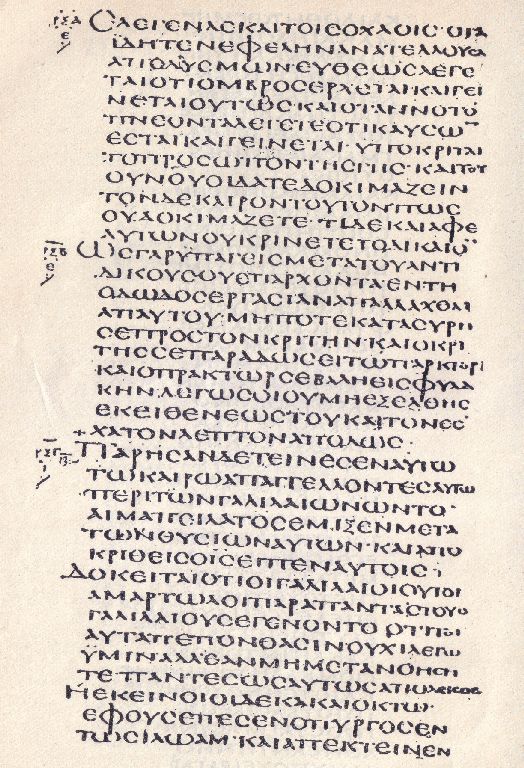
A leaf from the Codex Alexandrinus, a 5th century copy of the Bible in the Byzantine textual tradition.
This question came to me from a parishioner: “In the Lord’s Prayer, why do we say, ‘For thine is the kingdom and the power and the glory forever,’ if it is not in the Bible?”
I thought it was such a good question, I wanted to share my answer here for everyone’s benefit.
There are basically two issues at play. One is pretty simple and the other is a little more complicated.
First the simple one. Though our modern bibles tend to omit the phrase, “For thine is the kingdom and the power and the glory forever,” it has a very long history of being used in worship in the church. For example, the Didache is a Christian text written in the first century AD (around the year 90AD) shortly after the Bible itself was completed. Didache has quite a bit in it about worship, and it text has the long ending of the Lord’s Prayer in it. So we know that this line was used in worship from the earliest times.
Also, there is certainly nothing wrong with the phrase. The words themselves come from 1 Chronicles 29:11-13:
Yours, O LORD, is the greatness and the power and the glory and the victory and the majesty, for all that is in the heavens and in the earth is yours. Yours is the kingdom, O LORD, and you are exalted as head above all. 12 Both riches and honor come from you, and you rule over all. In your hand are power and might, and in your hand it is to make great and to give strength to all. 13 And now we thank you, our God, and praise your glorious name. (1 Chronicles 29:11-13 ESV)
So, there’s certainly nothing wrong with praying this part of the prayer. It is theologically sound and it is biblical. Furthermore, it has a long tradition in the worship of the church (as long as can possibly be).
So, what is the conclusion? It is fine to pray this part of the prayer and it is also fine not to. It is simply a matter of choice. The one who does not pray it is fine not to do so, and the one who prays it is likewise fine. This is what we call in theological discussions a matter of adiaphora, which is Greek for a choice which is left to one’s discretion.
Now to the second, more complicated, issue. This part of the discussion involves the history of the texts of the Bible as well as the history of the Protestant Reformation.
You ask, “Why do we pray [it] when it is not in the Bible?” Well, the fact that this is not in the Bible is not certain. This is a matter of debate among biblical scholars. Granted most biblical scholars will say that it is not original to the text of Matthew. But this is a guess on their part. A very educated guess based on solid scholarship, yet a guess nonetheless.
You see, the text of the New Testament you hold in your hand is based on two different families of manuscripts. One family is called the Alexandrian and the other the Byzantine. On 99% of New Testament these two families agree. Yet they differ on some points. The ending of the Lord’s Prayer is one of them.
First let me tell you about these two families of texts. By far, most of the Greek manuscripts of the New Testament that we (and by “we” I mean the scholarly community) have are of the Byzantine family. The oldest of the Byzantine texts dates back to the 4th century. That’s about as far back as we go with complete texts of the Bible. The Byzantine family is also the basis for the text used in the King James Bible.
Then we have the Alexandrian family. There are far fewer texts of the Alexandrian family and they weren’t discovered until the 19th century or so (when I say discovered, I mean that Western scholars didn’t know about them). Biblical scholars like the texts of the Alexandrian family because they are cleaner (meaning there are fewer variations between them) and they omit some of these section of the bible (like the ending of the Lord’s Prayer and the long ending of Mark). For biblical scholars, shorter = simpler = less contaminated = closer to the original. Almost always when the Byzantine differs from the Alexandrian, biblical scholars will go with the Alexandrian. This is a generalization, but it is normally the case.
So the New Testament you hold in your hand is mostly of the Alexandrian family, while the King James is of the Byzantine. Thus there are the differences.
Now for the Church history part (if you are still with me I commend you!). The Greek version of the New Testament was not copied very much in the West (by “West” I mean Europe, for the most part), because the Western Church relied on the Latin Vulgate as their main biblical translation. St. Jerome translated the Bible from the original Hebrew and Greek in the 4th century. Jerome was an excellent scholar, and his translation is pretty good, as long as you can read Latin.
The Reformers understood that most people couldn’t read Latin and their emphasis was to get the Bible into the language of the people. Some of the earlier (before the Reformation) translations of the Bible, into English for example, were done from the Latin Vulgate, which isn’t a horrible thing, but it is one step removed from the original.
At the time of the Reformation there was a parallel academic movement called “humanism” and one of the tenets of humanism was ad fontes, which means “return to the source.” Thus the humanists, whether they were Protestant or Roman Catholic, were seeking to produce a text of the Bible in the original languages of Hebrew and Greek. Erasmus was one of these humanists who became a Roman Catholic. Luther was another who, of course, became Protestant.
In search of Greek texts of the New Testament the humanists were forced to go to the Byzantine family, because it was all they could find. Thus the earliest modern versions of the Greek New Testament were of this Byzantine type and subsequently the English translations coming out of the Reformation were also of Byzantine type. As a result, they all uniformly included the long ending of the Lord’s Prayer.
We also have to appreciate the church politics going on here. The Roman Catholic worship service did not include the long ending of the prayer. Imagine when the Protestant Reformers discovered that the exclusion of the long ending in the Roman version of the Prayer was not biblical! They certainly were going to include that version of the prayer in their Reformed worship services, now weren’t they?
Also these Byzantine texts were coming from the Greek Orthodox Church. That’s because they continue to use the Greek text of the New Testament as their Bible to this day. The Reformers had some affinity to the Greek Church because, well, they weren’t Roman Catholic. Furthermore, the Greek Church represented a church that was every bit as old as the Roman Church and was at odds with the Roman Church just like they were. So you can imagine why the Protestant Reformers would have some reason to side with the Greeks on this issue. If you read any writings from the Reformation era you will see how bitterly at odds they were with each other.
So, as a matter of liturgical history, the long ending of the prayer was not used in Roman Catholic services but it was in Protestant ones. This is still mostly true to this day.
Fast forward to the 19th century. In the 19th century Western scholars discovered some biblical texts that were different from the texts they were used to. They began to see similarities between these newly discovered texts and saw that they formed a family of texts. This is when they began to call one family Alexandrian (because it comes from Egypt) and the other Byzantine (because it comes from Greece).
Now the picture of the history of the Bible became a little clearer. What seems to have happened with the Lord’s Prayer is that in the Greek East the longer ending was added to the prayer. This did not happen in the Western churches because Jerome (who was based out of the Middle East) likely used an Alexandrian text type for his translation into the Latin. So we have two strands of liturgical history: the Western churches not using the long ending, but the Eastern churches do use it. Thus we see that at a very early date (as far back as we can go) the Byzantine texts have the long ending, but the Alexandrian texts do not.
But who is to say if the Byzantine ones added it, or the Alexandrian ones somehow lost it? Who’s to say that there weren’t two copies of Matthew circulating? Who’s to say which one is correct? We are supposed to confess and believe that the academicians hold the key to the truth on this matter. Yet their own method directly privileges one textual tradition, the Alexandrian, over another and almost always goes with the shorter reading (which almost always is the Alexandrian). They say, and this is not a bad argument, that textual corruptions naturally enter into a text over time. Thus the Byzantine text has more corruptions. Yet because the Alexandrian texts were hermetically sealed in a vacuum they were free from corruption for something like 1,500 years. Think of the woolly mammoth frozen in ice. You can see why they prefer the Alexandrian if this narrative is true.
At first glance this sounds good. Yet what are we to do with the church for 1,500 years that had this particular “corrupted” Byzantine text? Was the Spirit absent with the church during this time? It is a complicated question.
In my Bible (an ESV) the footnote says, “Some manuscripts add For yours is the kingdom and the power and the glory forever. Amen.” And in the study note (it is the ESV Study Bible) it says, “This is evidently a later scribal addition, since the most reliable and oldest Greek manuscripts all lack these words, which is why these words are omitted from most modern translations,” (emphasis added).
Now, I think I take issue with that. The oldest? Well, technically maybe. The two oldest and best (and by best here I mean complete) examples of the Alexandrian tradition, the Codex Sinaiticus and the Codex Vaticanus, both date to the 4th century. The oldest and best examples of the Byzantine, the Codex Alexandrinus and Codex Washintonianus, date to, wait for it… the 4th or 5th century. Oldest? Not by much.
What about “most reliable”? That’s a judgment based on the “hermetically sealed” and “shorter = better” parts we were talking about above. Yet if both the Alexandrian and the Byzantine were circulating at the same time from the earliest of dates 300s-400s (Which is, by the way, when the making of books as opposed to papyrus scrolls became more of the norm. Codex is another word for a book.) who’s to say which is better? What about the argument that the text that “won” should be privileged in a reading like this? There’s no debating that up until 100 years ago the Byzantine text had won, at least among those who actually spoke Greek. The Alexandrian text had for all intents and purposes disappeared and was not a version of the Bible that was actively being used. It was a museum artifact. We have to ask ourselves why the Byzantine came to be privileged over the Alexandrian. What was the role of the Spirit in all of this? Again, complicated questions.
So, you see, the “fact” that this is not in the Bible is not a certainty. It has been in the Bible in the East for 2,000 years. It was not a part of the Bible in the Latin West for 2,000 years. It has been in the Bible for the Protestant West for 500 years. It has recently been again removed from the Bible in the Protestant West.
Back to my point on adiaphora. Whether or not this is in the Bible, it is certainly fine to say it. It is a Protestant tradition to say it, and this tradition connects with the oldest traditions of the Church.
My preference is to say it because it is the more catholic (universal) thing to do, in other words, more Christians over the scope of Christian history, and even today, have said it, so I’ll go with saying it.
But if the church across the street does not say it, it’s OK too. It’s not something to worry a whole lot about, in my opinion.
I bet that was a whole lot more than you ever figured you would get out of that question!
I love shrimp. Low Country Boil is just another shrimp delivery device (and one not mentioned by Bubba IIRC) that combines the key male necessities of eating with one’s hands, quick preparation and cooking, cooking outside with large propane fueled contraptions and huge pots that may or may not be converted beer kegs, delivering a large amount of tasty food for little cost and trouble, something do to while drinking beer and shooting the breeze, removing the need for things like plates, utensils, and the cleaning thereof, an occasion to use a small towel as a dinner napkin, and adding to the opportunity to eat shrimp other things men like to eat like sausage, taters, and corn on the cob.
I have found that the ladies also enjoy partaking of the Low Country Boil.
Here’s my recipe that will feed 15 or so adults.
Ingredients:
4 pounds raw de-veined shrimp, peeled or not (as an aside, y’all know that’s not a vein, right?)
2 14oz Polish Kielbasa Sausages, cut into two inch pieces
3-5 pounds new (small) red potatoes, washed and cut in half.
2 packs of 12 frozen mini ears of corn (shucked and de-husked)
1 can of Old Bay seasoning
4 lemons, halved
2 medium onions, peeled and quartered
butter, salt, ketchup, and cocktail sauce
3 gallons of water
1 big honkin’ pot and the means to cook with it
OK so prepare all that food. Make sure you have a heat source that will boil a bunch of water. Here’s mine:
Big honkin’ Bayou Classic Banjo burner. Beer can shown for scale.
Throw all your taters and onions in that pot and then add 3 gallons of water and dump the whole container of Old Bay in there. Turn on the heat and bring to a boil. After you get to a boil wait five minutes, stirring periodically. After five minutes add the sausage and the corn. After you return to a boil, wait another 10 minutes, stirring as the Spirit leads. After 10 minutes check one of the taters to make sure it’s done. They are done when they are good and soft. Now add the shrimp and boil for 3-5 minutes or until the shrimp are pink.
Next you have to get rid of all the water. My “pot” is fitted with a spigot on the side (it doubles as a brewing kettle). Some folks have specially made colanders that they can lift out of the boil. Before I added the spigot, I fished out the food with a colander that has a handle on it. However you can manage.
Next, pour all it all out on a table covered in newspaper, spray that lemon juice all over it, and eat that mess of food. Do your corn up right with butter and salt, and dip your shrimp in the cocktail sauce and taters in the ketchup if you like. Be sure to have lots of towels handy to wipe your hands.
This recipe will feed 15 or so but if you have a large pot you can feed even more. We are going to do a church picnic soon feeding 50+ people. Lot’s of fun.
Don’t forget to drink beer and play washers or cornhole or something while you wait and after you eat.
There has been much discussion on the interblags lately concerning Protestant conversions to the Roman Catholic church. This discussion has shown up on my Facebook feed and has raised some questions, so I thought I would write a post in order to address some of those questions. I also thought that I might offer my own perspective on the issue.
There have been several blog posts which have done a good job getting at some of the relevant issues. These can be seen here, here, and here. While these posts are good enough to stand on their own, I want to add a bit to the discussion from my perspective as one holding a PhD in Historical Theology and one who was specifically trained and wrote my dissertation in early medieval ecclesiology.
To my Roman Catholic Friends First of all I must pay heed to the great elephantoid presence among us and say something to address my friends who are Roman Catholic, many of whom converted to the Roman Church from Protestantism. I realize that seeing a series of articles linked to my Facebook wall and seeing a post like this on my blog may be unsettling or even offensive to some of you. To this I would like to say two things. First of all, this post is not directed to Roman Catholics. My purpose in writing this is not to try to convert anyone, even if I could. This post, as well as the others I have posted are written to Protestants. I realize that some of the arguments we are using may strike a nerve with some of you because they may be addressing some of the issues you faced when you converted, yet this is not my intention. I hope that you will grant an indulgence to us as we have an “in house” discussion. Secondly, I am a Presbyterian for a reason. I have not converted to Roman Catholicism, though I have heard all the arguments for it (over many pints with some of you at mid-town St. Louis pubs). I would hope that you would grant me that latitude to express my Presbyterian distinctives, as I would you if you would express yours.
To the Protestants in the Room It seems to me that the essence of this discussion boils down to a matter of ecclesiology. What is the nature of the church? Until we have understood and come to terms with a common definition of what the church is, we will not be able to address the issue of conversion to the Roman church. So what is the church? Our Roman Catholic brethren will claim that the church is defined by apostolic succession. What do we Protestants have against the apostles? Well, nothing at all. We all profess that the church is apostolic. The rubber meets the road, however, with how we define apostolic succession. They define it as an uninterrupted succession of bishops who are a part of a physical succession of laying on of hands that goes all the way back to the apostles. Sounds neat doesn’t it? Sounds pretty persuasive.
The only problem is that the bible doesn’t define the true church this way, and neither did the catholic church before the late middle ages. I don’t have a copy of Denzinger on me, but I would guess that, as with most things, the doctrine of apostolic succession as we know it today was not articulated until the Council of Trent. Nevertheless, even the article from the New Catholic Encyclopedia on “apostolic succession” admits that all the churches did not even have bishops until the 2nd or 3rd century, and that in many churches before that time rule was by a college of presbyters, what we today call a presbytery.
Now, this article is not a defense of Presbyterianism, so let’s not get off track. What I’m trying to do is talk about what is apostolic. It seems that before the time of Tertullian and Irenaeus (by the turn of the 3rd century) apostolic succession was held by all ordained pastors, not just the bishops. Clement of Rome in his letter to the church at Corinth espouses such an idea. Later on, it seemed expedient that the bishop become the sole authority and the-buck-stops-here’er with regard to defense of orthodoxy. Now, that is known, as I have argued to my Roman Catholic friends, as changing the rules in the middle of the game. Because if apostolic succession is defined by an unbroken chain of ministers laying hands on ministers going all the way back to the apostles, then we certainly have claim to it.
Yet I’m not even trying to make the claim that Protestants have apostolic succession. At least not yet. My purpose in writing this article is to argue that apostolic succession is not, nor never was intended to be, the marker of unity with the true church. In its inception, apostolic succession was a concept used to defend the true faith against heresy. Yet if you were to ask Tertullian or Irenaeus what the marks of the true church were, they would likely tell you that it was adherence to the orthodox faith and that unity was centered around the sacraments. This may seem like splitting hairs, but it becomes important at the Reformation. The claim of the Reformation is that the Church of Rome had departed from the apostolic faith. So what matters more, adherence to the apostolic faith, or adherence to an artifice that was once helpful in preserving the apostolic faith? No, the definition of the church cannot be changed in the middle of the game. The definition of the church and the symbol of its unity has always been centered around faith in Jesus Christ and the sacraments of baptism and the Eucharist, and not on its form of government.
This was how the early medievals viewed the matter. In Western Europe from the 5th-10th centuries, or so, there was an influx of new peoples into the church who were formerly pagan, or Arian, Germanic tribes. Rome was in decline, so Rome could not be depended on for help. The local bishops were largely laymen of aristocratic class who were educated in the palace courts. Who then would lead the charge for evangelism, revival, and church building in this strange new world?
The answer is that it came largely down to monks. Monks who were trained to be local parish pastors, evangelists, missionaries, and apostolic bishops. Yet how did these churchmen, who were seeking to unite the large swath of newly converted Europe into the church of Christ, how did they define the church? Was it the bishops?
No. The early medievals did what they did with almost any theological issue (or any issue at all, for that matter), they went to the bible. And what they found was that the bible defines the church as those who believe in Christ and who are unified by means of the sacraments of baptism and Eucharist. What then was to be the continual driving force of unity in this nascent European civilization? The Eucharist. The Lord’s Table was the place where all men and women came to be united into one body of Christ and one, holy, catholic, and apostolic church. This, if you are interested, was also the view of St. Augustine.
[Addendum: It is interesting to note that before the separation from the East and the West and before the separation of the Reformation, the church was defined around the Lord’s Table. It was only after these splits that other definitions were sought]
So what does this mean for me if I am considering the Roman Church? It means that if you are looking for the Catholic Church you may find it right where you are. The Catholic Church exists wherever the apostolic faith is professed, and the table of the Lord is held open to all baptized disciples of Jesus. If you are looking for something ancient, you will find it there: the table of the Lord was instituted by Christ himself. If you are looking for tradition, you will find it there:St. Paul says that he handed down the tradition of the Eucharist as he received directly from Jesus. If you are looking for unity with the Catholic Church, you will find it there: Sts. Paul and Augustine say that anyone who partakes of the body of Christ becomes and is in union with the body of Christ. If you are looking for salvation, you will find it there: Jesus says in the gospel of John that those who eat his flesh and blood will have eternal life. I love how Peter Leithart recently put it in this blog post: the Eucharist makes the church. That hits the nail on the head. It’s no coincidence that Peter found this insight by reading a book by Cardinal Henri de Lubac where he wrote about the early medievals and their concept of the body of Christ.
So what are you looking for? Are you looking for something ancient, some old traditions, something catholic, something salvific? You can find it at the Eucharist at your own local church.
Are you looking for certainty? Are you looking for an authority that will never be shaken? Well, you will not find it there, but sadly, you may find that you won’t find it in Rome either. The only source of truth we have is the Holy Spirit speaking through the scriptures to his people. The only certain authority we have is the Lord Jesus Christ who rules over his church. Everything else can and will fail and err.
So put your faith in Christ. And be Catholic just where you are.