
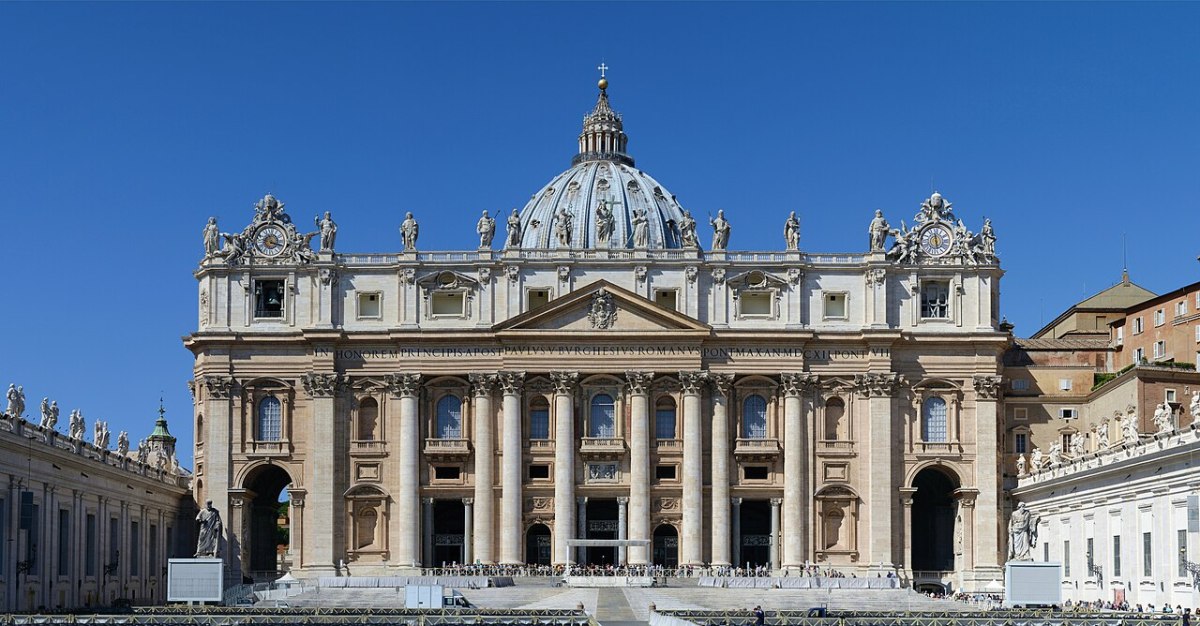
Many of us have had friends, family, or church members leave a Protestant church for Roman Catholicism.* What are we supposed to do or say in these instances, as friends? as family? as fellow church members? as pastors and elders?
I want to add a bit to the discussion from my perspective as one holding a PhD in Historical Theology and one who was specifically trained and wrote my dissertation in early medieval ecclesiology. I’ve also been a professor of Church History for 13 years and have been a pastor for 17 years. Having gone through this situation several times, I have learned a bit about what to do and what not to do.
A matter of ecclesiology
It seems to me that the essence of this discussion boils down to a matter of ecclesiology. What is the nature of the church? Until we have understood and come to terms with a common definition of what the church is, we will not be able to address the issue of conversion to the Roman church. So what is the church? Our Roman Catholic brethren will claim that the church is defined by apostolic succession. What do we Protestants have against the apostles? Well, nothing at all. We all profess that the church is apostolic. The rubber meets the road, however, with how we define apostolic succession. They define it as an uninterrupted succession of bishops who are a part of a physical succession of laying on of hands that goes all the way back to the apostles. Sounds neat doesn’t it? Sounds pretty persuasive.
The only problem is that the bible doesn’t define the true church this way, and neither did the early church. Even the article from the New Catholic Encyclopedia on “apostolic succession” admits that all the churches did not even have bishops until the 2nd or 3rd century, and that in many churches before that time rule was by a college of presbyters, what we today call a presbytery.
Apostolic Succession in the Early Church
This is demonstrated by the writings of Clement of Rome and Ignatius of Antioch. Both were bishops around the turn of the 2nd century (100AD). In their writings they demonstrate a parity of bishops and presbyters, evidence a form of church government that is a hybrid of presbyterian and episcopal systems.
In your typical Church History text you will see Clement and Ignatius pitted against each other as presenting opposite systems and almost as opponents: Clement for the presbytery and Ignatius for the monarchical bishop. However there as absolutely no evidence for them being opponents and their writings, when closely examined, actually agree with each other.
Here is the oft cited passage from Clement. In this section he is discussing who the successors to the apostles are. Notice that he states that the presbyters are the successors to the apostles:
Our apostles also knew, through our Lord Jesus Christ, and there would be strife on account of the office of the episcopate.
2 For this reason, therefore, having obtained complete foreknowledge of this, they appointed those leaders, previously mentioned, and afterwards gave instructions, that when these should fall asleep, other approved men should succeed them in their ministry.
3 We are of opinion, therefore, that those appointed by them, or afterwards by other eminent men, with the consent of the whole Church, and who have blamelessly served the flock of Christ in a humble, peaceable, and disinterested spirit, and have for a long time possessed the good opinion of all, cannot be justly dismissed from the ministry.
4 For our sin will not be small, if we depose from the bishop’s office those who have offered the gifts blamelessly in holiness.
5 Blessed are those presbyters who, having finished their course before now, having taken their obtained departure at a mature and fruitful age; for they have no fear that anyone would remove them from their appointed place.
(1 Cl. 44:1-5)
Now, while it would be inaccurate to say that Clement here espouses presbyterianism, it is clear that in some sense bishops and presbyters are the same thing. Clement never actually uses the term “presbytery” but it seems fairly clear from this and other sources that he was the presiding bishop over a college of presbyters. It is significant to note that in the Roman Catholic Church, Clement is considered to be the fourth in the line of the bishops of Rome, otherwise known as popes. This pope seems to be saying that the successors to the apostles are to be ordained by other presbyters, including the bishop. Otherwise, he is saying that all bishops are presbyters and all presbyters are bishops. This seems to place apostolic succession in the hands of the presbytery not in the bishop alone.
This notion of submission to the presbytery is also found in the writings of Ignatius of Antioch. As I said earlier, Ignatius is typically presented as having the opposite view to Clement. But ironically, while Clement never mentions the presbytery, Ignatius seemingly can’t stop using the word. He repeatedly praises the presbytery in his writings and exhorts Christians to be subject to the presbytery and obey the presbytery’s authority. Now to be clear he does direct the recipients of his letters to obey their bishop. In his letter to the Ephesians he writes, “Thus it is proper for you to run in harmony with the mind of the bishop,” (Ig Ep 4:1), “Let us, therefore, be careful not to oppose the bishop, in order that we may be obedient to God,” (Ig Ep 5:3), “We must regard the bishop as the Lord himself,” (Ig Ep 6:1).
Strong language. But we must also see that he also says similar things about the presbytery: “It is therefore proper that you should in every way glorify Jesus Christ, who has glorified you, that by a unanimous obedience being subject to the bishop and the presbytery, you may in all respects be sanctified,” (I. Ep. 2:2). Ignatius speaks like this in many of his letters. He says:
- “For your presbytery, which is worthy of its name and worthy of God, is attuned to the bishop as strings to a lyre,” (Ig Ep 4:1)
- “All of you, individually and collectively, gather in grace…. in order that you may obey the bishop and the presbytery with an undisturbed mind,” (Ig Ep 20:2).
- “Subject to the bishop as to the grace of God and to the presbytery as to the Law of Christ,” (Ig Mg 2:1).
- “It is essential, therefore, that you continue your current practice and do nothing without the bishop, but be subject also to the presbytery as to the Apostles of Jesus Christ,” (Ig Tr 2:2).
- “You must follow the bishop as Jesus Christ followed the Father, and follow the presbytery as you would the apostles, and give reverence to the deacons as being instituted by God,” (Ig Sm 8:1).
These are also very strong statements. They seem to set up the bishop in the place of Christ and the presbytery as his apostles. So who then are the successors to the apostles? He also seems to agree with Clement that it is the college of presbyters led by the bishop that rules the church. Again, it is a hybrid of the presbyterian and episcopal systems, and apostolic succession comes through the presbytery.
Now, this article is not a defense of Presbyterianism, so let’s not get off track. What I’m trying to do is talk about what “apostolic” means. It seems that before the time of Tertullian and Irenaeus (by the turn of the 3rd century) apostolic succession was held by all ordained pastors, not just the bishops, as Clement and Ignatius demonstrate. To later say that apostolic succession must come through bishops seems like changing the rules in the middle of the game. If apostolic succession is defined by an unbroken chain of presbyteries laying hands on ministers going all the way back to the apostles, then those of us who have ordinations through historically connected** churches certainly have claim to apostolic succession.
True unity in the Church is found through Word and Sacrament
Even so, apostolic succession is not, nor never was intended to be, the marker of unity with the true church. In its inception, apostolic succession was a concept used to defend the true faith against heresy. Yet if you were to ask Tertullian or Irenaeus what the marks of the true church were, they would likely tell you that it was adherence to the orthodox faith and that unity was centered around the sacraments. This may seem like splitting hairs, but it becomes important at the Reformation. The claim of the Reformation is that the Church of Rome had departed from the apostolic faith. So what matters more, adherence to the apostolic faith, or adherence to an artifice that was once helpful in preserving the apostolic faith? No, the definition of the church cannot be changed in the middle of the game. The definition of the church and the symbol of its unity has always been centered around faith in Jesus Christ and the sacraments of baptism and the Eucharist, and not on its form of government.
This was how the early medievals viewed the matter. In Western Europe from the 5th-10th centuries, or so, there was an influx of new peoples into the church who were formerly pagan, or Arian, Germanic tribes. Rome was in decline, so Rome could not be depended on for help. The local bishops were largely laymen of aristocratic class who were educated in the palace courts. Who then would lead the charge for evangelism, revival, and church building in this strange new world?
The answer is that it came largely down to monks. Monks who were trained to be local parish pastors, evangelists, missionaries, and apostolic bishops. Yet how did these churchmen, who were seeking to unite the large swath of newly converted Europe into the church of Christ, how did they define the church? Was it the bishops?
No. The early medievals did what they did with almost any theological issue (or any issue at all, for that matter), they went to the Bible and the Church Fathers, especially Augustine. And what they found was that the Bible defines the church as those who believe in Christ and who are unified by means of the sacraments of baptism and Eucharist. What then was to be the continual driving force of unity in this nascent European civilization? The Eucharist. The Lord’s Table was the place where all men and women came to be united into one body of Christ and one, holy, catholic, and apostolic church. This was also the view of St. Augustine.
Conclusion: No one needs to convert to the Church of Rome to be Catholic
So what does this mean if I or someone I love is considering the Roman Church? It means that if you are looking for the Catholic Church you may find it right where you are. The Catholic Church exists wherever the apostolic faith is professed, and the table of the Lord is held open to all baptized disciples of Jesus (Acts 2:42). If you are looking for something ancient, you will find it there: the table of the Lord was instituted by Christ himself. If you are looking for tradition, you will find it there:St. Paul says that he handed down the tradition of the Eucharist as he received directly from Jesus (1 Cor 11:23). If you are looking for unity with the Catholic Church, you will find it there: Sts. Paul and Augustine say that anyone who partakes of the body of Christ becomes and is in union with the body of Christ (1 Cor 12:12-14; Sermo 272). If you are looking for salvation, you will find it there: Jesus says in the gospel of John that those who eat his flesh and blood will have eternal life, and 9th century theologian Paschasius Radbertus concurs (John 6:54; De corpore 1). I love how Peter Leithart put it in this blog post: the Eucharist makes the church. That hits the nail on the head. It’s no coincidence that Peter found this insight by reading a book by Cardinal Henri de Lubac where he wrote about the early medievals and their concept of the body of Christ (de Lubac, Corpus Mysticum).
So what are you looking for? Are you looking for something ancient, some old traditions, something catholic, something salvific? You can find it in the Eucharist at your own local historically connected** Protestant church.
Are you looking for certainty? Are you looking for an authority that will never be shaken? Well, you will not find it there, but sadly, you may find that you won’t find it in Rome either. Rome has made some horrible mistakes. The only source of truth we have is the Holy Spirit speaking through the scriptures to his people. The only certain authority we have is the Lord Jesus Christ who rules over his church. Everything else can and will fail and err.
So put your faith in Christ. And be Catholic just where you are.
* I use the term “Roman Catholic” because the term “Catholic” is reserved for all historically connected churches that express the orthodox faith of the Bible. The Reformers did not shy away from using the term “Catholic” to describe themselves, and neither should we.
** “Historically connected Protestant Church,” is defined as a church descended from on of the national/regional churches of the Protestant reformation, such that its pastors were ordained by lawfully ordained priests, if not bishops, and thus have a continuous line to the Apostles. This would not include non-denominational churches that do not have ordination from a body that is historically connected to the Catholic Church.

