
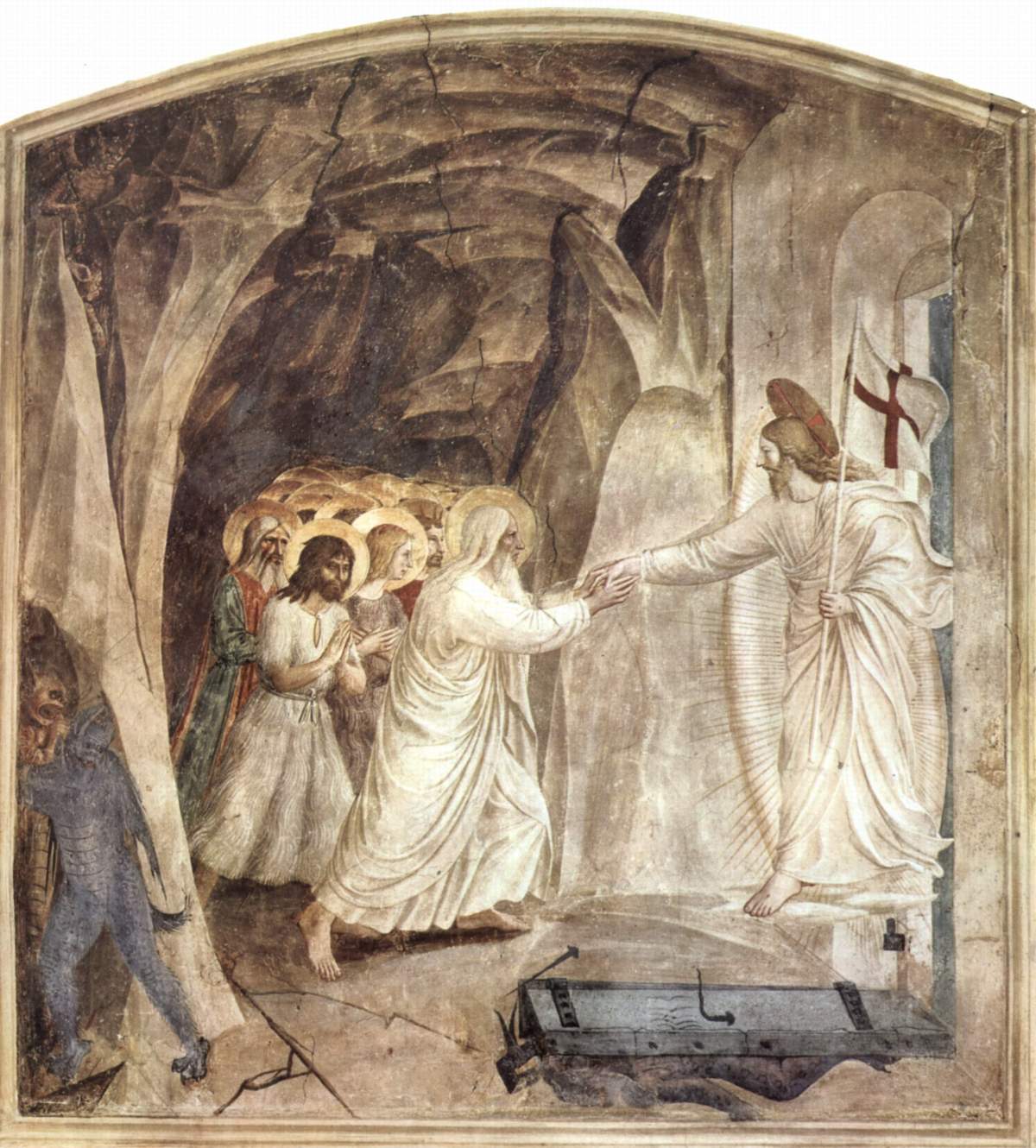
He Descended into Hell

At the church I pastor, New Life Ithaca, we say the Apostles’ Creed every week. I also say it a couple of more times a week when I pray the daily office. All told, I’ve recited the Apostles’ Creed thousands of times. 

I still remember the first time I said it. I grew up Pentecostal. We didn’t say creeds. I heard more than one preacher say, “No creed but Christ.” But that is itself a creed isn’t it? And we had a declaration of faith, which is a creed as well. But I digress.

The first time I ever said the Apostles’ Creed was at an African Methodist Episcopal Church. The mother of my high school friend Carl had tragically died at a young age and a group of us went to the funeral to support him. The funeral was a traditional liturgical service, as I know now, but very foreign to me then. As a part of the service we recited the Apostles’ Creed. I remember scrutinizing it in my head, especially the parts about believing in the catholic church and that Jesus descended into hell.

I’ve written quite a bit about Catholicity. But what of the descent clause? Did Jesus go to hell?

This Holy Saturday, I thought it appropriate to share a bit of what I’ve learned about this over the years. Holy Saturday commemorates the time between Jesus’ death and resurrection. It has historically been a time that emphasized rest and stillness. But at the same time, it has been seen as the time period when Jesus was “harrowing hell.” According to this ancient view, while Jesus’ body rested in the tomb, his spirit entered hell to declare his victory over Satan and to lead out the host of righteous dead from sheol/hades into heaven. We see in this ancient view, that Jesus did not enter the hell of fiery torment in order to suffer for our sins. He entered victoriously and “led a host of captives in his train.”[1]

While this harrowing of hell, or something like it, may have happened, the Bible does not explicitly say so. The only text that even mentions Holy Saturday is a half a verse at the end of Luke 23:56, “On the Sabbath they rested according to the commandment.” Psalm 68:18 and Ephesians 4:8 seem to allude to this harrowing, and some take Ephesians 4:9 to refer to Jesus’ descent into hell, the Latin even using a version of the word “inferno”.[2] Peter’s Pentecost sermon in Acts 2:27 and 2:31 also refer to Christ in hell, using the Greek word “hades” and the Latin word “inferno.” Further, 1 Peter 3:19 states that Christ preached to the spirits in prison. In context this refers to some declaration to the unrighteous regarding his lordship and victory. Psalm 107:16 and Zechariah 9:11 are also mentioned in support of this view as they seem to allude to Christ releasing captives from a deep pit.[3] But none of these explicitly say that Christ entered hell and plundered Satan on Holy Saturday. Again, it may have happened, and I tend to think that it did, but the Bible is not explicit about it.

The phrase in the Apostle’s Creed seems to be modeled after the Latin of Ephesians 4:9, but this is not certain. The Latin for this verse is, “descendit primum in inferiores partes terrae,” while the original Latin for the Apostles’ Creed is, “descendit ad infernos.” Notice that while the word “descended” is the same, the Vulgate uses the preposition “in” while the Creed uses “ad” and the Vulgate uses the word “inferiores” while the Creed uses “inferno”. These words are very similar, but not identical. 

For this reason there have been varying opinions of the meaning of the phrase “descendit at infernos” through the centuries. One view is based on what I’ve been describing, the harrowing of hell. This view was taught by several ancient fathers as well as medieval scholastics like Thomas Aquinas. Calvin’s view was that the phrase refers to the spiritual torment that Christ underwent on the cross (Institutes II:XVI:10). While this view is attractive, we have to admit that it is novel and not obvious from the Latin text of the creed. Luther’s view was that Christ literally entered into Hell, and many modern Lutherans share that view.

Calvin and later Berkhof point out that the phrase was included later on (Berkhof says that it appeared c. 390, which would date its appearance after even the creation of the Nicene Creed). Berkhof states that Christ could not have descended triumphantly into hell because his victorious resurrection hadn’t occurred yet and because that would contradict the period of rest that Christ’s statement “into your hands I commit my spirit,” implies. Berkhoff takes a view similar to Calvin’s, adding that the descent clause teaches the deepest humiliation of Christ in his death (Systematic Theology, 340-343). The Westminster Larger Catechism, question 50, takes a similar view, stating that the descent clause means that Christ truly died and remained under the power of death until the third day in his state of humiliation.

There is a marked difference between the Reformed view (Westminster and Berkhof) and the traditional view in that the traditional view presents Christ as already victorious while the Reformed view presents him still in a state of humiliation. The Reformed view has merit, as it asks the question, “How could Christ’s soul be victorious in hell while his body lay dead in humiliation?” I think that’s a valid question to raise.

Now to my view. My goal here is not to articulate another version or perhaps a synthesis of the above views, but to present a linguistic point. When we see the word “inferno” in the 21st century, we think of fire. That’s what the word means in English after all. So when we see the phrase, “He descended into hell,” we naturally think of the hell of fire. However, in the Latin usage of the time when the Creed was written the word inferno did not mean that yet. According to the standard Latin lexicon by Lewis and Short, the word meant, “underground, belonging to the Lower Regions.” Thus, “inferno” literally means “underworld”. What would be the biblical analog to this in Greek or Hebrew? It would be the Hebrew word “sheol,” or “place of the dead,” for which the Greek “hades” is used as a translation. None of these refer to a fiery place of the damned, but a place where even righteous souls rest when they die. 

OK, so why not say that then? Why not say, “He descended to the place of the dead?” Well, we are saying that. You see the word “hell” did not have the connotation of a fiery place of the damned until it gained an additional Christian meaning. The Germanic word “helle” simply meant the same as inferno: the underworld or place of the dead. You can see this in the Germanic word for paradise: Valhalla– “-halla” referring to the place of the dead.[4] Thus the English word “hell” in pre-Christian times meant just that: the place of the dead, with no connotation of fire or damnation. With this in mind, we really are saying, “he descended to the place of the dead” when we say “he descended to hell.” And what we mean by that is that Christ really died, i.e. his soul was separated from his body, and while his body lay in the tomb his soul visited the saints in sheol. 

As for the rest, whether he harrowed hell, proclaimed his victory to the damned, and led a host of captives out to heaven, there are scriptures that allude to this. But did it happen on Holy Saturday? I do not know. But I do know this. We will be able to ask him about it someday.


[1] Psalm 68:18 and Ephesians 4:8.

[2] But this translation relies on a dubious textual variant that Metzger, et al. rate as “C”, meaning the originality of the word “regions” is highly suspect and is more likely an explanatory gloss.

[3] John Calvin notes this and argues that Psalm 107 is referring to Israel’s captivity in Babylon and that Zechariah 9 is referencing a release from spiritual prison, Institutes II:XVI:9.

[4] See the entry for “hell” in the Oxford English Dictionary. That entry has a trove of information about the etymology and prior usage of the word. Significant is that in the earliest translations of the Bible into English, the Hebrew word “Sheol” was translated “hell,” meaning the place of the righteous dead.
A Biblical and Confessional Case for Requiring Background Checks for Church Officers

At last year’s General Assembly, an overture requiring background checks for church officers was defeated in the Overtures Committee. I don’t recall many of the arguments stated in the course of debate, but one I do remember was when a pastor stood up and said that we didn’t need background checks because no one knows a pastor better than his elders.

As the DASA report points out, “perpetrators are masterful at deceit and manipulation.”[1] In the report, we specifically tackled the myth of seemingly knowing a person:

7. I know him, and he couldn’t be an abuser!

Even specially trained individuals suggest it can be very difficult to identify an abuser in public settings. Image management is “used every day by abusers throughout the world.” Abusive people are very manipulative in their relationships. Deception is how they maintain power; therefore, they are well-versed at how to convince others of their innocence.[2]

Again, I will continue to commend the DASA report for reading and study as we consider these weighty issues.

One argument against requiring background checks that I have seen recently is another version of the grassroots argument. You can read it here. Additionally there have been some pretty extensive debates on x.com under the #pcaga hashtag.

While I do recommend that you read the article and form your own opinion, I will summarize the central argument as this: background checks are good, but we shouldn’t require them because that would be requiring a church to spend money, which is a violation of BCO 25-10. While others on x.com have adequately refuted parts of this: BCO 25 is about real property, the BCO and RAO require other expenses like paying for officers to attend the meetings of Presbytery and GA and printing and binding your minutes for review, etc.

However, here I want to briefly deal with a Biblical and Confessional rationale for why we should require background checks for not only church officers (that’s a good start) but also for anyone who will be in direct contact with children on a regular basis.


A Biblical Argument for Background Checks

Let us begin with a key scriptural mandate. Deuteronomy 22:8 states, “When you build a new house, you shall make a parapet for your roof, that you may not bring the guilt of blood upon your house, if anyone should fall from it.” Building a parapet on the roof of your house is a reasonable protective measure. It will not prevent any and every possibility of a person falling from your roof, including someone intentionally trying to throw themselves off the roof, but it is required in scripture because it will save lives and it is a reasonable expense to undertake.

This is also true of background checks. Like parapets, there are different kinds of checks of varying quality and comprehensiveness. Some, like running a name through a state police database, may only cost $20. A full record search of federal, state, and local databases and court records may cost around $200. In the same way there are flimsy parapets and there are very sturdy well made ones that are harder to get over.

Background checks are also similar to parapets in that a background check, even the most comprehensive one, will not identify every predator. That’s because the person hasn’t been arrested and convicted, or, if they have, they’ve pled down to a lesser offense. Thus, a background check will not identify every predator, just like a parapet can’t stop everyone who is hellbent on throwing him or herself off a roof. Nevertheless, building a parapet is a biblical mandate because it is a reasonable expense to make in order to prevent some injury and death. We can reasonably apply this biblical principle to background checks, therefore I fully support an amendment to our BCO to require them for officers.


The Confessional Argument for Background Checks

Now onto the confessional mandate for background checks. We begin with our duties and sins forbidden as church leaders under the fifth commandment:

WLC 129  What is required of superiors towards their inferiors? A. It is required of superiors according to that power they receive from God, and that relation wherein they stand, to… protecting, and providing for them all things necessary for soul and body: and by grave, wise, holy, and exemplary carriage, to procure glory to God, honour to themselves, and so to preserve that authority which God hath put upon them.

WLC 130  What are the sins of superiors? A. The sins of superiors are, besides the neglect of the duties required of them… careless exposing, or leaving them to wrong, temptation, and danger; provoking them to wrath; or any way dishonouring themselves, or lessening their authority, by an unjust, indiscreet, rigorous, or remiss behaviour.

It is our duty as leaders of the church, under the Fifth Commandment, to protect those under our care and not to carelessly expose them to danger. Not obtaining a comprehensive background check for anyone who is going to be in authority in the church is a violation of the Fifth Commandment, and thus it is completely appropriate for the Constitution of the PCA to require that expense.

Lastly, we will move to the Sixth Commandment.

WLC 135  What are the duties required in the sixth commandment? A. The duties required in the sixth commandment are, all careful studies, and lawful endeavours, to preserve the life of ourselves and others by… avoiding all occasions, temptations, and practices, which tend to the unjust taking away the life of any; by just defence thereof against violence,… and protecting and defending the innocent.

WLC 136  What are the sins forbidden in the sixth commandment? A. The sins forbidden in the sixth commandment are… the neglecting or withdrawing the lawful and necessary means of preservation of life,… and whatsoever else tends to the destruction of the life of any.

I focus on the Sixth Commandment here because all forms of abuse essentially boil down to a violation of the commandment not to murder, as I discuss in the DASA Report.[3] A further confessional mandate for requiring background checks for church officers is found under the duty to preserve life, by both avoiding practices that endanger life and acting to preserve it. Further, a willful neglect or withdrawal of lawful and necessary means of preserving life is a grave sin. A comprehensive criminal background check would absolutely prevent a known predator from doing more harm. If a known predator came to your church, a background check would enable you to identify him and take proper protective measures. It’s true, as I state above, that background checks will not catch every predator, but they will identify some of them and it is unconscionable not to use that tool to protect the flock of Jesus Christ from wolves intent to do them harm.

Because I do believe that neglect of this particular measure to protect life is a sin, I also believe that our Constitution should mandate background checks for church officers.


Postscript

I have heard some say that there are people who appear on sexual offender registries that are not predators. This is where I will put in a plug for one of the DASA Report’s items of advice to churches and presbyteries:

5. That competent third parties be engaged by Presbyteries, churches, and other PCA ministries when allegations of abuse arise.[4]

 If, in the course of obtaining a background check or running a name through a registered sex offender database, your church finds out that someone has been convicted of a crime related to abuse, and that person claims that it was a misunderstanding or youthful indiscretion, or whatever, you should never take that person at their word. There is too much at stake! You should then find someone who knows what they are doing (me, for example) and let them help you navigate the process of determining exactly what happened so you can make a better judgment and set good policy going forward. If it truly was that a guy mooned someone 20 years ago, that can obviously be forgiven and the person restored. But how will you know unless you look deeper into the matter? This is the moment to obtain police reports, sentencing statements, and charging documents. These will tell the fuller picture. Then get some help determining what your next step should be. With this information and assistance your Session or Presbytery can make the best possible decision in the interests of justice and protection of the flock of God.


[1] M49GA, p. 1139. See also pp. 962, 964, 1007, 1009, 1047, 1053, 1061, 1062, 1082, 1105, 1116, 1139 1198, 1239, and 1247.

[2] Ibid., p. 1221.

[3] “The locus of many sinful behaviors falling under the heading of abuse is found in the sixth commandment,” M49GA, p. 974

[4] Ibid., p. 951.