I love this story! It reminds me of another socially awkward “smart” kid from rural South Carolina who was given an opportunity to thrive that he would have gotten no where else.
Yes, Virginia, I am talking about myself.
Kudos to the state of South Carolina for continuing to support this wonderful school for gifted young South Carolinians. It’s sort of like Charles Xavier’s school (if you are familiar with X-Men). Gifted children have to be taught how to deal with their gifts and harness them for the greater good of society.
I love this story! It reminds me of another socially awkward “smart” kid from rural South Carolina who was given an opportunity to thrive that he would have gotten no where else.
Yes, Virginia, I am talking about myself.
The New York times did a wonderful piece on my high school alma mater highlighting how this school gives so many kids a chance to thrive in an environment where they will not be viewed as weird or abnormal, and encouraged to develop as complete human persons. I loved what one commenter on the NYT article said, “For me and many others, attending was a revelation. It was proof that we weren’t crazy; there were others like us.”
Kudos to the state of South Carolina for continuing to support this wonderful school for gifted young South Carolinians. It’s sort of like Charles Xavier’s school (if you are familiar with X-Men). Gifted children have to be taught how to deal with their gifts and harness them for the greater good of society.
Introduction There does not seem to have been any distinctive everyday dress for Christian pastors up until the 6th century or so. Clergy simply wore what was common, yet muted, modest, and tasteful, in keeping with their office. In time, however, the dress of pastors remained rather conservative, as it is wont to do, while the dress of lay people changed more rapidly. The result was that the dress of Christian pastors became distinct from the laity and thus that clothing began to be invested (no pun intended) with meaning.
Skipping ahead, due to the increasing acceptance of lay scholars in the new universities, the Fourth Lateran council (1215) mandated a distinctive dress for clergy so that they could be distinguished when about town. This attire became known as the vestis talaris or the cassock. Lay academics would wear an open front robe with a lirripium or hood. It is interesting to note that both modern day academic and clerical garb stems from the same Medieval origin.
Councils of the Roman Catholic church after the time of the Reformation stipulated that the common everyday attire for priests should be the cassock. Up until the middle of the 20th century, this was the common street clothes attire for Roman Catholic priests. The origin of the clerical collar does not stem from the attire of Roman priests. Its genesis is of Protestant origin.
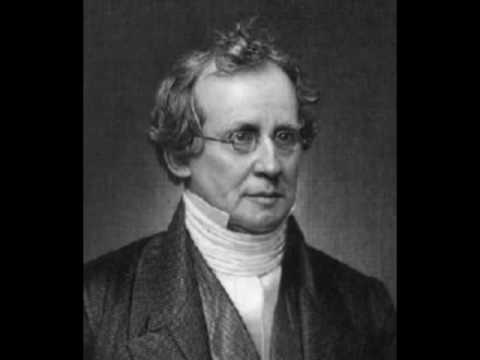
The Origin of Reformed Clerical Dress In the time of the Reformation, many of the Reformed wanted to distance themselves from what was perceived as Roman clerical attire. Thus many of the clergy took up the attire of academics in their daily dress or wore no distinctive clothing whatsoever. Yet over time the desire for the clergy to wear a distinctive uniform returned to the Reformed churches. What they began to do, beginning in the 17th century as far as I can tell, is to begin to wear a neck scarf, called a cravat, tied around the neck to resemble a yoke. Thus common dignified attire was worn by the pastor, supplementing it with this clerical cravat. This style can be seen in many of our famous Reformed divines, one of the more famous of whom being Charles Hodge.
Charles Hodge pictured with clerical cravat
When Reformed pastors would enter the pulpit, they would add what is known as a “preaching tab” or “neck band” to their clerical dress. This type of dress is nearly ubiquitous among 17th and 18th century Reformed pastors. Here are a few examples:
Jonathan Edwards featuring clerical cravat and preaching tabsGeorge WhitfieldJohn Owen – 17th century Reformed pastor
In the following picture we see more clearly the use of both the clerical cravat and the inserted preaching tabs by one Thomas Chalmers.
Thomas Chalmers, 19th century. Notice both the cravat and tabs clearly visible.
The reader will note that the men depicted here were of great eminence as Reformed pastors and theologians. They are all well known for their commitment to Reformed theology and biblical teaching and practice. These are not obscure men who sported clerical attire.
One might ask whether this sort of attire was universal among the Reformed. The answer is, no. Upon perusing several portraits included in the Presbyterian Encyclopedia of 1880, published by Presbyterian Publishing Co. of Philadelphia, I found that there was diversity of clerical attire chosen by Presbyterian pastors of the 19th century. Some wore clerical cravats. Some wore what looks like a modern rabat with a collarette (a black vest which closes at the top with a bit of white collar revealed all around). Others wore bow ties or neck ties. The conclusion to be drawn is that in the Presbyterian tradition, there has been diversity of clerical dress without any type enforced over the other.
Another objection that might be raised is whether or not this neck band or cravat, such as we see Charles Hodge wearing, was in any way distinctive clerical garb. Several 19th century sources reveal that these cravats were, in fact, considered distinctive clerical garb. The following quote is from a 19th century source called The Domestic Annals of Scotland, Volume 3:
In the austerity of feeling which reigned through the Presbyterian Church on its reestablishment there had been but little disposition to assume a clerical uniform or any peculiar pulpit vestments. It is reported that when the noble commissioner of one of the first General Assemblies was found fault with by the brethren for wearing a scarlet cloak he told them he thought it as indecent for them to appear in gray cloaks and cravats. When Mr. Calamy visited Scotland in 1709 he was surprised to find the clergy generally preaching in neckcloths and coloured cloaks. We find at the date here marginally noted that the synod of Dumfries was anxious to see a reform in these respects. The synod – so runs their record – “considering that it’s a thing very decent and suitable so it hath been the practice of ministers in this kirk formerly to wear black gowns in the pulpit and for ordinary to make use of bands do therefore by their act recommend it to all their brethren within their bounds to keep up that custome and to study gravitie in their apparel and every manner of way.”
Here we see several members of the 18th c. Church of Scotland (Presbyterian) having their hackles raised over some ostentatious clergymen wearing scarlet cloaks and cravats. Later they hold a Synod where they decide that they ought to wear black gowns and to make use of neck bands. This paragraph shows us two things: the wearing of cravats was considered to be distinctive clerical garb, and the synod of the kirk decided ultimately that modest use of neckbands was permitted. (There are many more such examples in 19th century sources which can easily be researched on Google Books. I invite the reader to see for himself.) Thus when we see all manner of 17th-19th century Reformed pastors sporting preaching tabs, neck bands, and cravats, we should interpret them to be intentionally sporting distinctive clerical garb. We should also gather that the author of these annals, one Robert Chambers, included this anecdote in his work in order to promote the modest use of bands and clerical garb in his day.
The last bit of history to cover regards the origin of the modern clerical collar. According to several sources, including one cited by the Banner of Truth website (no Romanizing group), the modern clerical collar was invented by a Presbyterian. In the mid 19th century heavily starched detachable collars were in great fashion. This can been seen up through the early part of the 20th century if one has watched any period television shows or movies. If we observe the collar worn by Charles Hodge we can see that at first these collars were not folded down as they are today, but left straight up.
Charles Hodge revisited. Notice the upturned collar protruding from the top of the cravat.
Yet in the mid to late 19th century it became the fashion of the day to turn these collars down. You and I still wear a turned down collar. The origin of the modern clerical collar is simply then to turn or fold the collar down over the clerical cravat, leaving the white cloth exposed in the middle. According to the Glasgow Herald of December 6,1894, the folded down detachable clerical collar was invented by the Rev Dr Donald McLeod, a Presbyterian minister in the Church of Scotland. According to the book Clerical Dress and Insignia of the Roman Catholic Church, “the collar was nothing else than the shirt collar turned down over the cleric’s everyday common dress in compliance with a fashion that began toward the end of the sixteenth century. For when the laity began to turn down their collars, the clergy also took up the mode.”
Yet two questions arise: how did the clerical collar then fall out of use among Presbyterians and how did it come to be so associated with Roman Catholic priests? The answer is that up until the mid 20th century the prescribed dress for all Roman Catholic priests was the cassock, a full length clerical gown. Yet during the 20th century it became custom for Roman Catholic priests to wear a black suit with a black shirt and clerical collar, which collar they appropriated from Protestant use. Owing to the large number of Roman Catholic priests in some areas, and due to the fact that some sort of everyday clerical dress was mandated for all priests at all times when outside their living quarters, the clerical collar became to be associated more with the Roman Catholic Church than with the Protestant churches. It stands to reason that once again a desire to create distance between the Reformed and Roman Catholics and the increasing desire throughout the 20th century for ministers to dress in more informal ways has led to the fact that barely any Reformed pastor wears any distinctive clerical dress these days, though plenty of examples show that our eminent forbearers desired to do so.
The apostle Paul tells us in 2 Corinthians 3:18 that, “we all, with unveiled face, beholding the glory of the Lord, are being transformed into the same image from one degree of glory to another.” How is it then that the Spirit is transforming us from glory to glory?
The pattern of maturation in the scriptures is a progression from priest to king to prophet. The priestly phase is a propaedeutic phase of keeping rules and doing things exactly according to the book. This corresponds to our childhood which is full of rules. The kingly phase is a phase of ruling and exercising dominion in the vocation that God has given us. This corresponds to the main phase of our adult life. The prophetic phase is a phase of increasing influence and wisdom based on a lifetime of knowledge and experience. This phase corresponds to our “golden years” which all to often in our culture are discounted by the younger generation. Biblically speaking, the prophetic phase is the most glorious and most influential, though we tend to value the kingly phase the most in our culture.
The bible also shows us that moving from glory to glory is preceded by a time of testing. The first test is the wilderness trial, where the person must deal with the Heavenly Father and come to terms with their personal loyalty to him. This trial is shown in Israel’s wilderness wandering as well as Jesus’ 40 day temptation in the wilderness. At the end of the wilderness trial, Joshua says, “Choose you this day whom you will serve,” (Joshua 24:15). Passing this test makes one ready to become a priest, where performance is measured by doing exactly what God says, and blessings/curses are meted out accordingly.
The second test is the garden trial. The garden trial is a test to see if one is willing to lay down his life for others, specifically his bride. The garden trial is shown in the scriptures in Adam’s test by the serpent in the garden as well as Jesus’ temptation in Gethsemane. Being willing to lay down one’s life for the sake of others is the test that is required to move into the kingly phase of life and ministry, which requires exactly that one lays down one’s life on behalf of those which he (or she) has been given to rule. The kingly phase is marked by wisdom, and the exactness of the rules of the priestly period are stretched (and sometimes broken) according to the wise rule of the king.
The third test is the fiery trial. The fiery trial is a test to see if one will pass on the kingly rule and all the things which one has built to the younger generation of junior kings. The fiery trial is shown in the bible in several places: Abraham’s sacrifice of Isaac, Elijah’s handing down his ministry to Elisha, and Jesus sending the Holy Spirit to his church on Pentecost. Passing the fiery trial (which involves both being willing to let go of our “sons” as well as passing our ministries down to them) makes one ready to become a prophet. Being a prophet in the bible is the most glorious and the most influential. Where the king is taken up with the day-to-day aspects of ruling, and his influence is largely over those he rules, the prophet has time to spend influencing and impacting the greater world. Prophets in the bible are world changers. They usher in new covenants and phases of redemptive history. They have power to rebuke and instruct the nations of the world, not just the local Israel. Being a prophet means one has remained faithful through the three major tests of life, and that one has gained a treasure trove of wisdom and knowledge based on his life experiences, knowledge of the scriptures, and close connection with God. Prophets should always be listened to, and never discounted in the church.
For the most part we as Americans are good at getting to the kingly phase, but we stall before getting to the prophetic phase. How can we do a better job of passing the fiery trial and becoming world changers? Kings have power and influence, but prophets make kings and disciple the nations. This is the phase that we must most aspire to, and must value the most in our churches.




 Vita pastoralis