
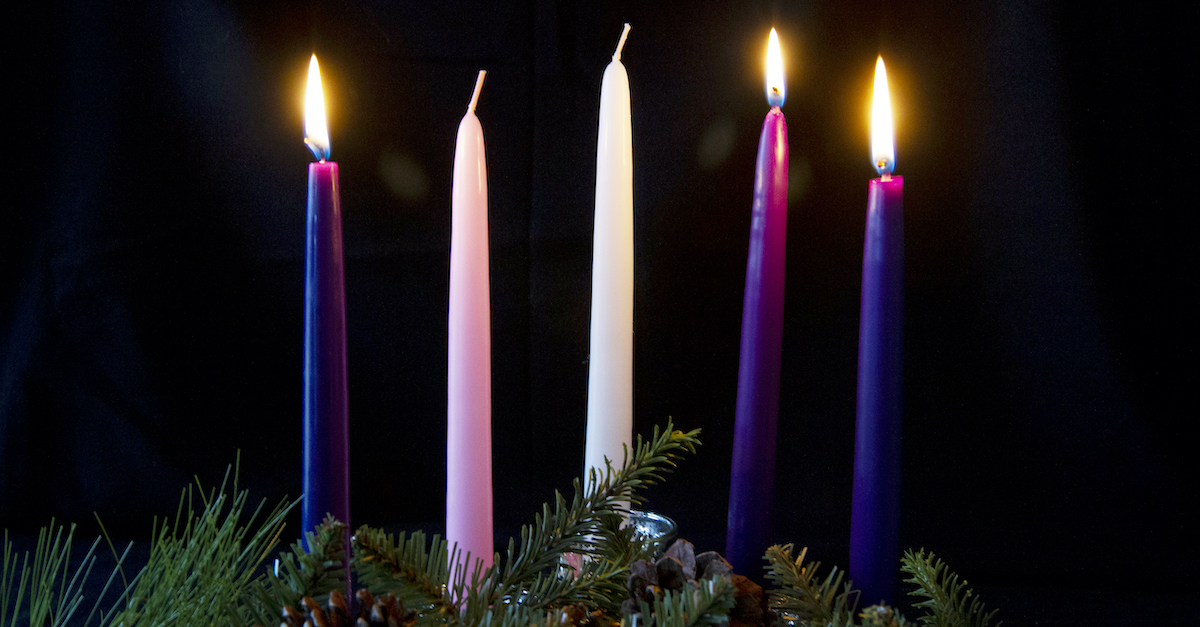
I have a pet peeve. Actually, I have several. This one has to do with the way that many churches do Advent, that is, as an extended time of Christmas. Their focus is on the first Advent of Christ, and the time is spent covering the biblical material leading up to his birth. Christmas carols and hymns are sung from the first Sunday of Advent onward and there is no distinctive Christmas season. In other words, Advent is Christmas.
There is just one problem. Advent is not Christmas.
Before I get any further I need to make several disclaimers. First, the purpose of this essay is not to shame anyone or call anyone out. I’ve observed this practice enough to not have any one particular church in mind. In fact, the church I attended this week on the First Sunday of Advent did it correctly. So, I’m not calling anyone out in particular and neither do I have any recent experience in mind. Second, my goal is not to cause anyone to feel ashamed or to cause any immediate, drastic changes in your church. My purpose is to educate and train. The church year is a secondary (or even tertiary) matter, and there’s no reason to go to war over how anyone does the church year (or doesn’t).
That said, if we are going to do the church year, I think that it ought to be grounded in what the Scripture teaches and what the church has observed over the centuries, and that as Reformed Christians we ought to have a good rationale and purpose for doing it.
In this essay, part one of two, I will cover the broader biblical and historical aspects, that is – the Biblical and Patristic Roots of the Church Year. Then in part two I will get into the nitty gritty of why Advent is not Christmas (and why that matters).
The Church Year is Grounded in God’s Word
The church year is not just a cool thing that trendy churches are now doing. While I think it’s good that all kinds of churches are getting in touch with the roots of historic Christianity, as we do that we need to understand what we are doing and why. Ancient does not necessarily equate to good and helpful, and we need to understand what unhelpful aspects may have developed in ancient practices so we can avoid them. When it comes to the church year, we are not just appropriating church tradition. It turns out that, as in many other things, the church’s tradition is grounded in God’s Word.
There are some folks (I happen to be one of them) that believe that whatever we do in the worship of God should be grounded in God’s word. In other words, we can’t do whatever we like in our worship of God. The Bible teaches us how we are to worship, and our worship should be regulated by God’s Word. This idea is referred to by Reformed theologians as The Regulative Principle of Worship.
There are three places we can find the church year grounded in God’s word: the creation narrative, the Mosaic law, and in New Testament observance. The first is in creation itself. In Genesis chapter one we find that light is created on the first day, but the Sun, Moon, and stars aren’t created until the fourth. Light existed before day four— it evidently was a manifestation of God’s glory. Much like the waters were gathered on day three to produce the dry land, the light is gathered on day four to produce the Sun, Moon, and stars. The Sun is said to rule over the day, and the Moon to rule over the night. The Sun, Moon, and stars are given to “to separate the day from the night,” and to serve as indicators of “signs and for seasons, and for days and years,” (Gen. 1:14). The Sun marks the day, the Moon marks the month. The stars mark seasons. Together, all three help us mark years. But did God create all this just for telling time?
The text says they are for “signs and seasons, and for days and years.” Why is the word “signs” in with “seasons, days, and years”? It seems to show that the heavenly bodies will not just mark the passage of time, but that they serve as important markers throughout the year. The word sign used there appears several times in the Old Testament, but two of its usages are as a pledge of the covenant (circumcision, rainbow, and Passover are all signs) or as a marker of divine action. One way to think of these celestial signs are as creational ebenezers, heavenly stones of remembrance, that move us to mark the mighty deeds of the Lord in worship as we move through each year of our lives. Further, the word used for “seasons” here is almost always used in the Old Testament with a connection to worship. It can mean an “appointed place,” in which case it almost always refers to a particular spot in the Temple/Tabernacle, or to the Tent of Meeting itself. As an appointed time, it most regularly refers to the time for appointed feasts. This is how the BDB Hebrew Lexicon defines this usage in Genesis 1, preferring the translation, “for signs and sacred seasons.” This is also the case in Psalm 104: 19, which should be translated, “He made the Moon to mark the sacred seasons.”
This creational feature is encoded in the worship of the Old Testament Church. We find a series of yearly feasts prescribed in the Mosaic law. These feasts are largely agricultural, but they follow the cycle of the year. The movement of the Sun, Moon, and stars in their yearly cycle set the dates for the great festivals, especially those of the springtime.
Exodus 12 describes both the ritual of the Passover meal and the day that it is to be observed. The LORD tells Moses that this month, the month they were delivered from Egypt, is to be counted as the first month in their ecclesiastical calendar. We find that several other important events happen on the first day of the first month, including the day when the waters were dried after the Flood (Gen. 8:13) and the day when the desert Tabernacle was erected (Ex. 40:2, 17). The first day of the first month has also been traditionally thought to be the first day of creation. The first month of the year was calculated based on the first ripening of the barley harvest, a marker of springtime (see Leviticus 23). The first new moon after this marked the beginning of the first month. Then the next full moon marked the Passover. This is why to this day we calculate Easter based on the first full moon after the spring equinox. But more on this later.
After the Passover, the people of God were to celebrate Pentecost, which was dated 50 days after the Passover (Lev. 23:15-16). Thus, Passover and Pentecost were the two great feasts of the springtime. There were also two fall feasts, which are described in Leviticus 23: Trumpets and Booths (also called Ingathering in Ex. 34:22). All four of these festivals marked significant events in the Exodus story. Two other feasts were added to the calendar at later points. The feast of Purim celebrates the deliverance of the people of God as told in the book of Esther. It is held yearly in the last month of the ecclesiastical year (Adar, see Est. 9:18ff). Hanukkah, an early winter feast, was added during the intertestamental period in the month Kislev to celebrate the Maccabees’ deliverance of the people from the Seleucids. Every year the people of God were to celebrate these feasts with eating and drinking and worship services. These feasts had three aspects. First, they were thanksgiving feasts, based on the agricultural calendar of ancient Israel. Second, they were memorial feasts marking out significant moments in salvation history. Third, they were formative feasts, teaching the people of God important theological truths. These three aspects, thanksgiving, instruction, and formation, will be criteria that we refer back to when evaluating Advent in part two.
In the New Testament we find that the people of God are still celebrating these feasts and references to them are sprinkled throughout. Passover is connected with Jesus’ death and resurrection. Pentecost, the day when the Law was given at Sinai, is connected with the coming of the Holy Spirit in the upper room. We also find Jesus attending Jerusalem for the Feast of Booths (John 7:2, 10), Dedication (Hanukkah) (John 10:22), and apparently also Purim (John 5:1-2). The only feast that is not mentioned explicitly in the New Testament is Trumpets along with its Day of Atonement. Perhaps this is because Passover and Eastertide are going to subsume them in the New Covenant.
Even after Christ’s death and resurrection we have references to the OT feasts in the New Testament. We cannot discount the fact that God chose the Mosaic feast of Pentecost to send the Holy Spirit upon the believers in the Upper Room. This seems to point not only to a New Covenant fulfillment of that feast, but to a continued New Covenant observance of it. Further, we read in Acts 20 that Paul desired to reach Jerusalem by Pentecost. He also mentions Pentecost in 1 Corinthians 16. With these positive participations in the ecclesiastical calendar, we find nowhere in the New Testament that the yearly calendar is to be abrogated. We find other aspects of the Mosaic law are abrogated: bloody sacrifices, circumcision, food laws, other holiness separation laws related to purifications and clothing, and others. But we do not find any abrogation of the ecclesiastical year. Instead, we find an encouragement from Paul to keep the feast, not the old feast of unleavened bread, but the new Pascha, that we now call Easter (1 Cor. 5:7-8). There Paul gives us the theological content of the Old Testament feast (cutting off the old leaven of malice and wickedness) and connects the Old Testament feast of Pascha to the sacrificial death of Christ on the Cross.
The Early Church Celebrated the Church Year
It’s hard to overstate just how important the leaders of the post-Apostolic church were in building the faith that we all profess and practice. Paul uses the metaphor of the Temple structure to describe how our faith has been established. In Ephesians 2:20 he states that our faith is, “built on the foundation of the apostles and prophets, Christ Jesus himself being the cornerstone.” In Paul’s conception though, the apostles, prophets, and Christ don’t make up the entire structure. They are the foundation, but the subsequent generations make up the rest of the building. Peter agrees, saying that we are “living stones” making up the structure of our faith, with Christ as the cornerstone, (1 Pet. 2:5). By the time the Apostles left the scene in the late first century, the foundations were laid, but the early church had to continue building.
The first Christian leaders after the Apostles understood this. The earliest extant Christian document outside of the New Testament, the Didache, purports to hand down instructions from the Apostles themselves on how the church should be organized. As it was written in Syria around 80 A.D. this is not a fantastic claim and should be taken seriously. Clement of Rome, writing to the church at Corinth around the same time, described the problem of who would be the successors to the Apostles and carry on their leadership of the church. In chapter 44 of his letter he writes that the Apostles had designated ordained presbyters to be the successors to their ministry. Ignatius of Antioch, writing after the turn of the century, writes that the people should be subject to the bishop led presbytery, that bishops and presbyters are in tune with one another like strings on a guitar, and that the bishops have the mind of Christ (Ig. Eph. 2:2, 3:2, 4:1). Some scholars have posited that Clement and Ignatius present alternative visions for church government in the early church, but I believe they represent an identical polity, one that is a hybrid of episcopal and presbyterian systems. But I digress.
Those early Christian leaders also addressed the problem of the apostolic vacuum by arguing that the writings of the Apostles were inspired and should be the basis for the fledgling faith. Both Ignatius and Clement demonstrate an awareness that what Peter and Paul wrote was inspired by God and thus authoritative, but that what they themselves were writing was neither inspired nor authoritative in the same way (1 Clem. 47:3, Ig. Ep. 12:1-2, Ig. Rom. 4:3). Thus, while the ordained presbyters were the successors to the Apostles in leading the church, they were bound by the writings of the Apostles in scripture as to what doctrines they elucidated and in their leadership of the church.
These two pillars of early Christian theology lead to the calling of the great ecumenical councils to deliberate and articulate the content of the faith in the presence of heresy. Those first four councils were the weight bearing joists and beams, laid on the foundation of the Apostles, that would support the faith for centuries and even millennia. The Niceno-Constatinopolitan Creed and the formulations of Ephesus and Chalcedon serve as our theological floor to this day. As the preamble to the Athanasian Creed would later expound, no one can be considered a Christian who does not profess the faith that those four councils describe.
But what does all this have to do with the church year? Did you know that when the Council of Nicaea was called in 325 A.D. one of the primary issues it met to deliberate on was the yearly day of the celebration of Easter? One of the more significant controversies of the early church was whether Easter should be celebrated on a fixed date (like Christmas is now) or whether it should be movable based on the calculation of Jewish Passover. The first issue discussed in the published canons of the council does address the issue of the Trinity, but the final act published was the solution of the Holy Pasch (see Decrees of the Ecumencial Councils by Norman P. Tanner). The council decided that Easter should be determined each year according to the practice of the Romans, which practice was developed based on the occurrence of the first full moon after the spring equinox. To this day this is how we determine when Easter will be.
The Nicene deliberation demonstrates two things for us. First is that for the earliest Christians celebration of the springtime ecclesiastical feasts was not a question of if, but when and how. Second, this demonstrates how important the concept of unity was for them (see John 17:20-26 and Eph. 4:3-6 for the reason why), and that unity was based on tangible, observable practices like worship and the celebration of ecclesiastical feasts.
In fact, the Church Fathers felt strongly that the church year should be practiced as a practical feature of the unity of the church. Athanasius of Alexandria is known first for his ardent defense of Nicene Orthodoxy and secondly for his being the first full articulation of the New Testament canon in 367 A.D. Yet Athanasius was also an ardent supporter of the church year, arguing that the 40 day fast of Lent should be a feature of the church’s worship throughout the world. The fact that the council of Nicea refers to the observance of Lent as a given further demonstrates this. (Please see my earlier essay on the origins of Lent for more information.)
Therefore, in addition to laying down our ecclesiological and theological framework, the Church Fathers bequeathed to us the Christian calendar. They redemptive historically transmogrified (to borrow a phrase from two of my seminary professors Jack Collins and Michael Williams) the springtime feasts of the Old Testament into a Christian liturgical calendar. The feast of Unleavened Bread became Holy Week and then Lent. The Day of Atonement became Good Friday. Passover and Trumpets became Eastertide (in fact the vast majority of the world still refers to what we call Easter as Pashca). Pentecost became, well, Pentecost, but the shift moved from Sinai to the New Sinai of the Upper Room and the coming of the Holy Spirit. That the New Testament writers place so much emphasis on the fact that these major events in salvation history occurred on these festal days, also arguing that the sacrificial system of worship itself was transmogrified and brought into the New Covenant in Christ, bolsters what the Church Fathers did. As in the case of canon, presbyterate, and creed, the Apostles laid the foundations for the church year, and the Church Fathers built upon it a sturdy floor for us to stand upon. In fact, continuing with our building metaphor, we might see that patristic doctrines of polity and scripture built the basement walls, the creeds of the councils laid the floor joists, and the liturgy of the Fathers created the weight bearing walls. What remained for later generations was to “dry in” the frame and then to provide the interior design of the place, making the house of our faith into a beautiful dwelling place for us with our God.
The Reformers Accepted the Early Church’s Calendar
To bring this forward a thousand plus years (I promise I will go back and fill in the medieval gaps in part two) the Reformers accepted the calendar that the Church Fathers developed. Even our Reformed forebears kept the major “evangelical” feasts, emphasizing that communion should be received on those days. For certain, the Reformed rejected the late medieval excesses of Lent, throwing out with that dirty bathwater the baby of patristic Lenten practice, but they did not reject the calendar outright. Martin Luther did not reject it at all, but reformed it, as was his practice in general. But even the Reformed kept the major feasts, while rejecting Lent and being more skeptical of Advent. All the Reformers were keen to reform the calendar of late Medieval excesses with its proliferation of Saints Days, which they felt distracted from the central story of Christ and his life. For this reason they accepted the framework of the church year that emphasized the major events of Christ’s life (birth, death, and resurrection) along with the coming of the Holy Spirit in the Upper Room. We see the pre-Puritan Reformed position clearly in Heinrich Bullinger’s Second Helvetic Confession where he writes:
If in Christian liberty the churches religiously celebrate the memory of the Lord’s nativity, circumcision, passion, resurrection, and of his ascension into heaven, and the sending of the Holy Spirit upon his disciples, we approve of it highly. but we do not approve of feasts instituted for men and for saints. Holy days have to do with the first Table of the Law and belong to God alone. Finally, holy days which have been instituted for the saints and which we have abolished, have much that is absurd and useless, and are not to be tolerated. In the meantime, we confess that the remembrance of saints, at a suitable time and place, is to be profitably commended to the people in sermons, and the holy examples of the saints set forth to be imitated by all.
For certain, Calvin was more critical of the church year than Bullinger, but he seems to be more concerned with perfunctory performance of them and those who we colloquially call “Chreasters”. Calvin’s Geneavan churches did keep the major holidays, and he preached sermons on their topics (the Nativity of Jesus on Christmas, for example) and served communion. His objections seem to be for pastoral reasons, specifically, that people were only showing up for major holidays and thinking their observance of them was enough for them spiritually. In spite of this, Calvin said that he did not think that observation of the major holidays should be abolished unless the majority of the church agreed.
This Evangelical (story of the gospel) Church Year is a concept I believe that we can all center around. Whether we choose to retain the Puritan rejection of all days save Sunday, go the Lutheran (as in Martin, not the denomination) route of major holidays with their seasons, or walk the Reformed middle way of Bullinger, hopefully we can see the biblical and patristic roots of the church year. In this we can have charity towards our brothers and sisters who observe certain days along with those who do not. Afterall, this is what is laid down by Paul in Colossians 2 and Romans 14, establishing the Apostolic principle that the Church year is a matter of adiaphora not dogma. Paul says we should not despise each other based on our observance of these days and that we should find our central unity not in them but in Christ.
While exercising this charity, the question remains whether the dominical and apostolic exhortations to maintain the unity of the church around the one faith, along with the practical applications of Christian formation that the church year presents, demonstrate the wisdom of the early fathers in building those weight bearing walls. I’m obviously arguing that case, while extending charity to my brothers and sisters who disagree and hoping for theirs in return.
In part two I will discuss that if we accept the wisdom of the Fathers and choose to observe the winter cycle of Advent and Christmas, we should do it in ways that are keeping with the patristic and biblical principles regarding the Church year, and that means, ultimately, that Advent is not Christmas.
 Vita pastoralis