
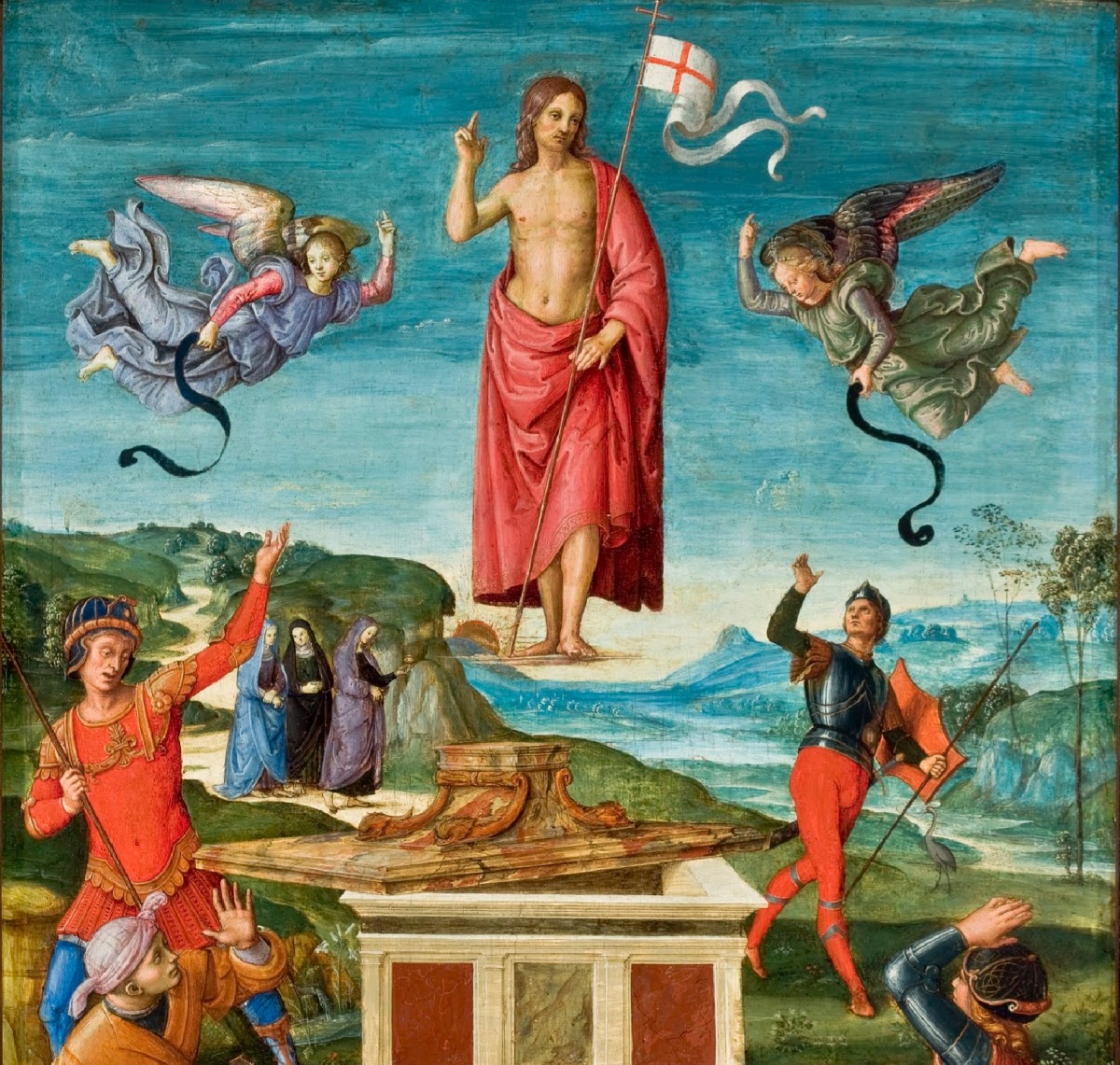
It is once again the time of year that folks begin to ramp up for Easter. Easter bunnies, Easter egg hunts, and other various trappings are beginning to be ubiquitous. Now, I will be the first to recognize that the secular (and especially corporate) focus on fluffy bunnies, eggs, and the like is an attempt to sterilize the explicit Christian content of Easter, specifically that of the resurrection of Jesus from the dead. Yet, I would also argue that Christians who wish to push back against that sterilized (if not secularized) view should not abandon these traditional symbols of Easter, but should fully embrace them and refill them with their Christian meaning.
The same can be said of Christmas. The traditional symbols of Christmas- St. Nick, trees, gifts, feasts- may have been sterilized, secularized, commercialized, and paganized, but that does not change the fact that St. Nick is a real Christian saint, that the Wise Men really offered gifts to the baby Jesus, and that trees and feasts also have their origin in biblical theology. No more should we as Christians abandon these symbols of Christmas than we should abandon the traditional symbols of Easter.
Yet, while I have asserted that the traditional symbols for Easter, including the word “Easter” itself, are Christian in origin, I have not yet substantiated that claim. What is my claim exactly? Well you may have heard that the word “Easter” is of German pagan origin. As a result we Christians sometimes get a little uneasy about using that word. In this post I set out to argue that the word “Easter” is not of pagan origins, and that the word “Easter” itself is actually a Christian metonym for the word “resurrection.”
What is a metonym exactly? A metonym is a word-symbol that represents another more abstract word that can be used in place of that word. For example, a scepter is something that a king or queen might hold as a symbol of their authority. Yet the word “scepter” itself can be used as a metonym for the word “authority.” In other words “holding the scepter,” can mean “possessing authority.” This is like when Jacob prophesies that the scepter will not pass from the hand of Judah in Genesis 49. There, the word “scepter” is a metonym for kingship or rule. Another way to think of it is that a metonym is a metaphorical or symbolical kind of synonym.
So the word “Easter” is a metonym for “resurrection.” Now, where do I get that? Well, from none other than the Oxford English Dictionary (OED), widely considered to be the definitive record of the English language. Now, as far as lexicographical philosophies go, the OED is descriptive and not prescriptive. In other words, what the OED sets out to do, in an academically rigorous fashion, is to describe the various usages of a word throughout the history of the English language. This is opposed to prescriptive lexicography, which is the notion that a dictionary should impose its view of language on others. As opposed to stating how a word should be used, rather, descriptive lexicography presents how words have been used already.
Now where I find the OED supremely helpful is in its record of word origins and etymologies. If we look to the entry for “Easter,” what we find in the etymological section is that the word is not of pagan German origin, but of Greek origin. What we find is that far back into our linguistic heritage (that would be the Indo-European family of languages) the word “east” has been a metonym for the rising of the Sun or the coming of the dawn. Thus the Old Dutch ōster, the Old Saxon ōstar, the Middle Low German ōsteren, or the Northumbrian Eostre, never found their origins in any pagan festival, but in the fact that the Sun rises in the East (der Osten is German for “the East”). Thus East(er) means dawn, or the rising of the Sun. This word “Easter” became associated metonymically with the vernal equinox in Germanic lands, and subsequently after their acceptance of Christ, the same word became metonymically associated with the Christian festival of the resurrection of our Lord.
Now the fact that Jesus rose from the dead at or near the vernal equinox is no coincidence. The vernal equinox has always been associated as the creation of the world (in the Hebrew conception), and Jesus is considered to have both been conceived and to have died at or near the vernal equinox, coinciding with the creation of the world and the Hebrew deliverance from Egypt (this is why the Introit for Easter Sunday is the Song of Moses from Exodus 15). Thus a new world comes into being through the resurrection of Christ at the same time of year that the world itself is growing in light (in the Northern Hemisphere) and at the exact point when that light begins to over take the darkness (which by the way is why Easter can never be before the vernal equinox, before the point of the year when light overtakes darkness).
Now, reader, you may also note that only German and English speakers call Easter “Easter,” while the rest of the world calls the festival “Pascha,” which is Greek for “the Passover.” Well let us ponder this for a moment. Germans and English live in much more Northern latitudes than do Greeks or Latins. Do you think that perhaps in the German mind, where the darkness of winter is so much more pronounced than in more southerly latitudes, the coming of the spring might so much more be associated with the resurrection of our Lord? In the most Northern parts of Europe, darkness nearly overtakes the day completely in the depths of winter. Easter then is the day when light finally has defeated the dark. For Greeks and Latins this astronomical reality is not so much of a big deal because they never experienced the disparity between light and dark during winter to the degree that the Germans did.
So, where did this misconception about Easter being pagan come from? The fact of the matter is that there is only one source in existence that claims that the word has such an origin. Now that this source is quite venerable (literally, in fact) explains the stubbornness of this myth. Sadly, it comes from one of my heroes of the faith, the Venerable Bede, the Northumbrian Saint, who while otherwise a very respectable scholar and theologian mentions in one place while talking about the origin of their word for the month April that the word Eostre comes from the celebration of a pagan godess. While Bede is quite the authority on most matters, there is no other source to collaborate this claim, and the OED states that this etymological claim is “less likely” (which is academic speak for not holding much water), and that some scholars think that Bede may have made the whole thing up (for what reason we cannot guess).
If we think about this logically we may suppose that there may have been a pagan feast for the coming of spring, and if so why wouldn’t there have been? Wouldn’t you celebrate the ending of the long dark winter if you lived in Northern Europe? Yet, the word Easter is not pagan in origin, but an ancient way of referring to the rising of the Sun and the coming of spring.
Besides, feasting is biblical in origin, so it is ever as much likely that the pagans started having a springtime feast in response to the Christian festival of the resurrection of our Lord.
So, don’t be afraid of the word Easter. Gladly and loudly go about wishing everyone a “Happy Easter!” this Sunday without reservation. Because Easter is not a bad word.


 Vita pastoralis