
Just So We’re Clear, Mary Did Know

This is silly. I can’t believe I’m doing this. (So don’t do it, LeCroy.) Sigh. I’m gonna do it.

There’s this song. It’s schmaltzy and sentimental, like many of the contemporary Christian songs I grew up with. If you like this song, I advise you to stop reading. Because I’m going to trash it.

I grew up in the glorious heyday of CCM, and I loved every minute of it. I went to their concerts. I sang their songs in church services and in youth talent competitions. I bought their tapes, read their books, and had their posters on my bedroom wall. Like most Evangelical teen boys growing up in the late 80’s and early 90’s I had a crush on Amy Grant. Later I had one on Rebecca St. James. I listened to the local CCM station non-stop, even as a kid sending in some of my meager dollars for their pledge drive. I’m not really cynical or bitter about it. I am mostly appreciative of such a wholesome upbringing in a non-ironic way. The point is, I’m an insider offering insider critique.

Here’s my critique: “Mary Did You Know?” is a terrible song. 

I mean, the tune is catchy enough. It sticks in your head like many of CCM’s greatest hits. There’s nothing like a good spirit-filled musical climax or key change to grease the skids on a flagging worship service (I grew up Pentecostal. Key changes were a means of grace for us. The Spirit seemed to always coincide with the high notes.). Aesthetically, it fits in with the era in which it was written. It’s in the Bill Gaither milieu, so it’s melodically rangy and adeptly uses musical climax to stir the emotions. The original recording was by Michael English in 1991. Michael English is an incredible singer. I saw him live once, because of course I did. You have to give that original a listen. Hoo, boy. It’s fantastic (now I’m being nostalgic and a little bit ironic, but in a good way). The music is Phil Collins and the vocals are Michael McDonald. There’s even a third verse drum entrance crescendo à laIn the Air Tonight.” So, as far as that goes, it’s not bad. In fact if you love 80’s music it’s glorious, if about a decade late as most CCM is.

But the lyrics. Ugh.

The author, Mark Lowry, is a great guy. He’s a comedian and singer who tours with Bill Gaither. But he’s not a biblical scholar or theologian, bless his heart.

I mean, the song is fine. If you like it, listen to it. Like the old adage about wine, if you enjoy it drink it. If you like Boone’s Farm, slurp it up, my friend. No judgment here.

But just so you know: Mary knew.

This is my biggest problem with the song. It’s inaccurate and unhelpful. (But, pastor, I just listen to it because I like the beat). We can go line by line through the song to illustrate this (and don’t worry, I will), but in general it presents a version of femininity in Mary that is not true to her or the other heroines of the Bible. It presents her as a clueless passenger in this journey instead of one of the key players. It woefully downplays the importance of her role. Not only did Mary have the perilous job of carrying the God-Man in her body to full term, consider this: the infant mortality in the Roman Empire was about 30%, and an additional 30% of children did not reach adulthood. That’s only a 40% chance of Jesus living to the age of 20. And that’s not even taking to account the fact that people were out there actively trying to kill him. Powerful people. With armies.

Mary’s job was to feed him, clothe him, and keep him safe. She also taught the young boy manners and took him to church. He learned to speak by imitating her. He had her accent. The Eternal Word of God learned human speech from this marvelous woman by watching her lips and imitating her sounds. And all indications are that she did it for the latter half of his life as a single mother.

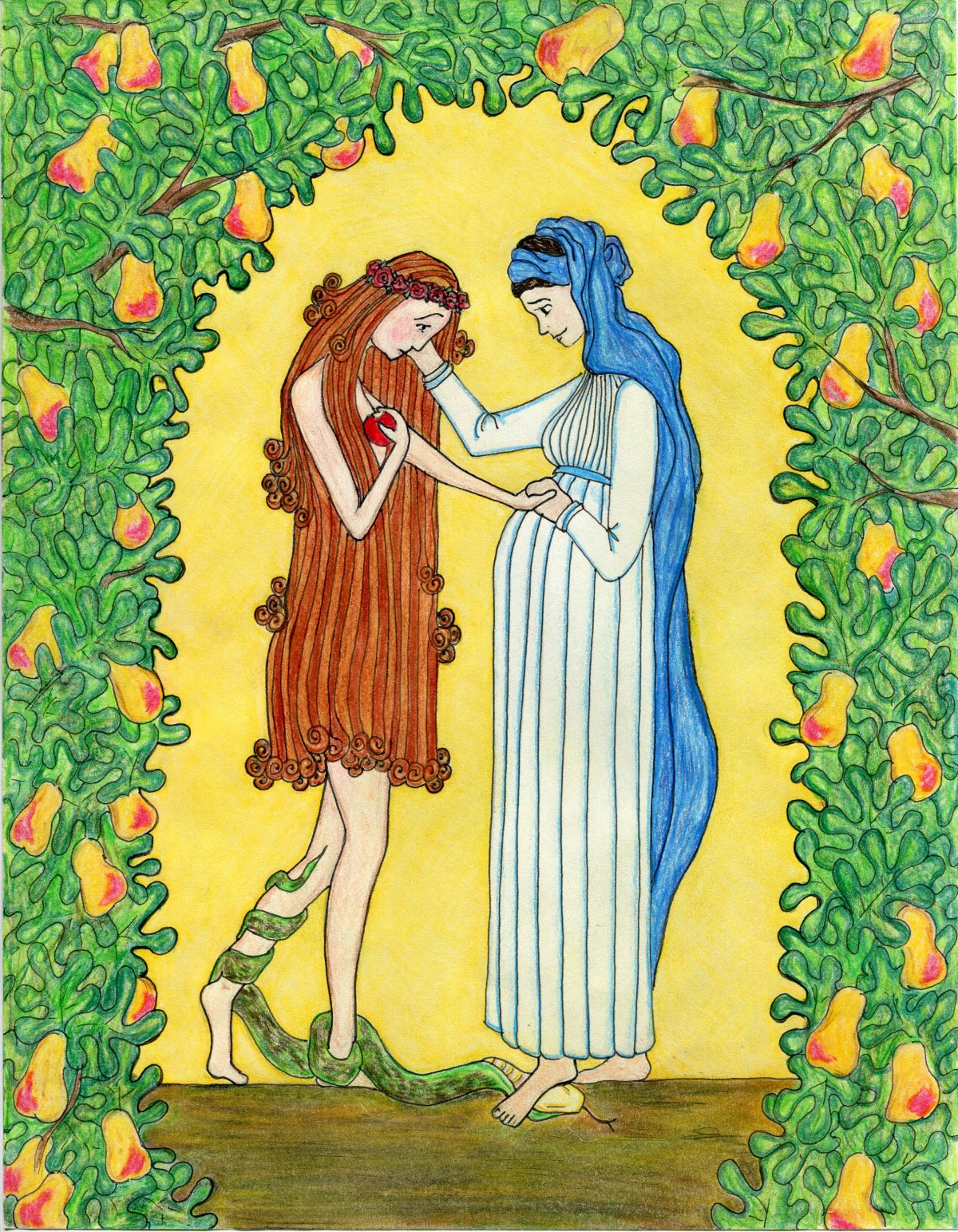
She did all of this while remaining faithful. She did not take the apple, as her mother Eve did. She was graced by God and did not waiver. She wept at the foot of the cross when the Apostles fled in fear. She was in the upper room on Easter evening and on Pentecost. She helped Luke write his Gospel. This was a strong woman, who stands at the pinnacle of all the heroines of the Old Testament. Higher than Deborah. Higher than Jael. She may not have crushed heads with her hands, but she raised the head-crusher par excellence. She was a Miriam (that’s her name, by the way) seeing her baby boy down the Nile to safety and then raising him to be the deliverer of her people. She is a leaping, dancing prophetess, singing on the shore of the Red Sea with the drowned army of the enemy lying submerged within. Only that beachhead was not in Arabia but in the hill country of Judea in response to a leaping, dancing fetus and a blessed declaration by her auntie. Yet the song is just as victorious and prophetic as the song of her namesake centuries before.

She knew.

Let’s put this to rest. The image of Mary as a passive, quiet bystander who just happened to be the human incubator of the most high, praised for her purity and her quiet virtue, is a product of wrongheaded ideas about sex, purity, and the human body which sadly dominated the early church and the middle ages. Mary was not virtuous because she was a virgin. She was a virgin because she was virtuous. And she didn’t stop being virtuous the moment she was no longer a virgin. I almost typed when she lost her virginity, as if virginity is a thing that can be lost and when you lose it you are damaged goods. There are some purity preachers who go about the country giving Christian teen girls shiny brand new pennies and telling them not to lose their virginity because then they will become tarnished. They need to keep their pennies shiny and bright so that they can give that gift to their husbands. What a load of hot steaming garbage! If a girl falls into sexual sin she hasn’t become any more tarnished than she already was, for heaven’s sake. She needs to repent of that sin and endeavor towards chastity in the future, but she isn’t damaged goods. The gift that she will eventually give her husband is not her virginity, but her very self and her promise to be his faithful wedded wife. We need to put this thing to bed for good. By the way, those same preachers don’t give the teen boys shiny pennies. What sexist nonsense!

I digress. Though, the image of Mary as meek and mild does come from that same purity culture. I could give you an in-depth history of the development of sexual purity culture, how it began as a result of the cessation of martyrdom and the rise of the monastic class in the early Middle Ages, but I’ll spare you that. The high-point of this insanity is demonstrated in the medieval idea that when Jesus was born he did not pass through Mary’s vagina, but miraculously passed through her belly, leaving her maidenhead intact. I’m not joking. Here’s the point: Mary’s virginity was not a virtue in and of itself. It was important that she be a virgin in order to serve as a symbol of the new creation and to prove that she conceived by the Holy Spirit. To further demonstrate this, Rahab is a mother of Jesus and she was decidedly not a virgin. Her former life of prostitution did not make her unworthy of mothering Messiah.

Mary was not a hapless damsel in distress, the prototypical medieval maiden cloistered in her embroidery with her ladies-in-waiting. She was a warrior princess. She was Eowyn of Rohan singing and slaying. Her Magnificat, sung on that Judean hillside, was a response to the devil whispering to her, tempting her to the apple saying, “No man can kill me.” That song and her courageous life afterward is her reply, “I am no man.”

She knew. Frankly it is insulting to ask her the question.

Let us analyze the lyrics of this song.

“Mary, did you know that your baby boy would one day walk on water?” Well, no, she wasn’t omniscient, but she did tell the servants at the wedding of Cana, “Do whatever he tells you,” (John 2:5). She knew her boy was a miracle worker.

“Mary, did you know that your baby boy would save our sons and daughters?” Absolutely, unequivocally, yes. She named him “Yahweh Saves.” The angel Gabriel told her to name him that (Luke 1:31). And the same angel told her husband this, “He will save his people from their sins,” (Matt. 1:21). I assume she and Joseph talked. Further, Zechariah, after his son John the Baptist was born, sang, “You have raised up a horn of salvation for us in the house of your servant David,” (Luke 1:69). Old Zech was long gone when Luke wrote his gospel. Who opened up the family photo album for him? It was Mary. She is the source for the material in the first two chapters of Luke. She knew.

“Did you know that your baby boy has come to make you new?” Yes, see above.

“This Child that you delivered will soon deliver you?” Yes. She literally named him “Deliverance.” Again, see above. Though I will grant that this is some nice word play.

“Mary, did you know that your baby boy will give sight to a blind man?” Yes, see Isaiah 28:19, Isaiah 61:1, Luke 4:18, and Matthew 11:5. Also see above that she knew he could work miracles.

“Mary, did you know that your baby boy would calm a storm with His hand?” Again, she was not omniscient, but she knew he would have power over nature as the divine Son of God. Gabriel told her that she would be impregnated by the Holy Spirit and that she would give birth to the Son of the Most High. Again, due to the evidence in John 2, apparently, she understood that meant that he had divine power. Elijah and Elisha demonstrated power over nature, so it’s no stretch to think that Jesus would. Plus, Gabriel told Mary and Joseph that he would be called Immanuel, God with us. She knew.

“Did you know that your baby boy has walked where angels trod?” Well, technically, he hadn’t done that. He didn’t have legs until he was born. Did she know he was a pre-existent deity? See above.

“And when you kiss your little baby you’ve kissed the face of God?” Ok, here’s the only one where I admit she probably didn’t know this. But maybe she did. All the evidence was there. I wouldn’t be surprised if she did know this. Gabriel did tell them to call him Immanuel, after all.

“Mary, did you know? The blind will see, the deaf will hear, The dead will live again, The lame will leap, the dumb will speak The praises of the Lamb!” Yes. Read the Old Testament prophecies about Messiah. They predict all these things.

“Mary, did you know that your baby boy is Lord of all creation?” I think she knew this. He was the Son of the Most High God that would rule over an everlasting kingdom (Luke 1:32-33). She knew he was Messiah and she knew all the glorious things described in Isaiah that Messiah would do. Psalm 110 depicts a Messiah who is the dread judge and ruler of all. She knew that he possessed divinity as the Son of the Most High. I don’t think it’s a stretch to say that she knew that he would be Lord over the entire creation.

“Mary, did you know that your baby boy will one day rule the nations?” Absolutely she knew this. Gabriel told her so, and see everything listed above. Also, take into account the Song of Simeon who declared that he was to be a “light to the nations,” (Luke 2:32). 

“Did you know that your baby boy was Heaven’s perfect Lamb?” OK, this is a good question. Did Mary know that Jesus was the agnus Dei? I think so. She knew that he was going to save his people from their sins. As a well-educated Israelite she would know the only way that could happen was through sacrifice. Further, when John the Baptist came on the scene, the first thing he said about Jesus is that he is the Lamb of God who will take away the sins of the world (John 1:29). How did he know that? Was it because the Spirit shot him through with an on-the-spot revelation? Or was this a well-known fact in the family from the time of Mary’s visit, Elizabeth’s declarations about Mary and Jesus, and Zechariah’s song? I think she knew.

“And the sleeping Child you’re holding is the great, the Great I AM?” See above. But here’s one more piece of evidence. When Mary visited Elizabeth, Luke records that the baby, John, leapt in her womb and she was filled with the Holy Spirit and started prophesying. The text says she then started singing. What was her song? “Blessed are you among women, and blessed is the fruit of your womb! And why is this granted to me that the mother of my Lord should come to me? For behold, when the sound of your greeting came to my ears, the baby in my womb leaped for joy. And blessed is she who believed that there would be a fulfillment of what was spoken to her from the Lord,” (Lk. 1:42-45). The mother of “my Lord,” she sang. Is that Lord like Master or Lord as a substitute for the word Yahweh? We can’t be sure that they understand it in the latter sense, but it’s certainly possible that they did.

“Oh, Mary, Mary, did you know?”

Oh, yes, yes, she did know.

Let us not forget the conclusion Luke leaves us with after relaying the Marian material to us in his first two chapters, “And his mother treasured up all these things in her heart,” (Lk. 2:51). Mary was not only the mother of Jesus, but she was his first disciple, as she replied to Gabriel, “Behold, I am the servant of the Lord; let it be to me according to your word,” (Lk. 1:38). She was a student of her son. She treasured these things in her heart and pondered their meaning. During those long nights of feeding him, of rocking him back to sleep when he woke up crying, she pondered the deeper meaning of these things as she poured over the Old Testament scriptures in her mind. Perhaps this is what gave her the resolve to stay faithful when others failed. When the apostles fled and Peter denied him thrice, she was there at the cross, remaining with him till the bitter end. She was there at the tomb on Easter morning. She was there in the upper room at Pentecost. What gave her that faith, that strength, that resolve when others doubted, disbelieved, denied, and fled?

She knew.

Image: Virgin Mary and Eve, Crayon and pencil drawing by Sr Grace Remington, OCSO, © 2005, Sisters of the Mississippi Abbey. Printed versions of this incredible image can be purchased here.

Visit New Life Presbyterian Church for more articles and teaching from Tim LeCroy. New Life is a church worshiping in the beautiful Finger Lakes region of New York serving both the Cornell University and Ithaca College communities.

Advent Is Not Christmas, Part 2: The Historical Development of Christmas and Advent

“I Hate Christmas.”

I once read an article in the Washington Post whose title was, “I hate Christmas.” It wasn’t entirely what I expected: an atheist curmudgeon annoyed by the ubiquitous seasonal Christian messaging, wishing that everyone would get off his god-free lawn. While there was a little bit of that in the piece, it was mostly centered around the fact that because the author grew up poor, he could never experience Christmas the way movies, tv shows, pop songs, commercials, catalogs, and even friends and family taught him he was supposed to experience it. His family could never afford the lavish feast, the tree surrounded with all the items on his Christmas wish list, or even a very nice tree. He now shuns Christmas along with its gatherings, festivities, gifts, and cheer, instead spending all the money he can afford buying toys for poor children so they can have the Christmas he never had.

I finished the article thinking that the author hadn’t rejected Christmas, he had rejected what Christmas has become: a commercialized cornucopia of instant gratification. What he had actually offered was a valid critique of Christmas and a call to recenter on its true meaning. After all, what more pure symbol of the Christmas spirit is there than sacrificing financially to provide gifts to poor children? St. Nicholas, anyone?

Afterward, I perused a bit of the comment section (yes, I know you are not supposed to read the comments). Many commenters agreed with the author. Some agreed because they were of other religions or were atheists (what I thought the article was going to be about). Others, though, didn’t reject Christmas but rather the spectacle that it has become. One commenter replied, “Only 2-ish weeks before the schizophrenia is behind us. My favorite day of the year is January 1, when it’s all over.”

Christmas Isn’t the Problem

Now don’t get me wrong, I love Christmas. If there was a hidden camera in my house it would catch me randomly singing, “It’s the most wonderful time of the year!” My wife and I have curated the biggest (and best) Christmas display in a three or four block radius (in our estimation… opinions may vary). I love the feasting. I love the gift-giving. I love the Christmas liturgies, hymns, and candlelight services. I love all that because I love the message of Christ born to set his people free. I love the message of Immanuel, God-with-us, that the God of the Universe took on every bit of our broken humanity so that he could redeem it all. I love it because the incarnation is the only sufficient answer to the problem of evil in this world, as the best philosophers have realized, St. Augustine at the head. I love it because he became sin, who knew no sin, that we might become the righteousness of God. That’s the reason I’m singing, “It’s the most wonderful time of the year!” That’s the reason why I’ve lit my yard up in multicolored c-9 ceramic bulb nostalgic glory. That’s also the reason why I’m ecstatic that the whole world pauses once a year to celebrate the fact that God was born into the world.

And yet, I resonate with what that Washington Post author wrote. Because he’s right. The Christmas message is not what Hallmark, Home Depot, Honda, Hanes, Harley-Davidson, Hurley, and Hasbro are selling us. We have gotten off the rails, or jumped the shark, or whatever metaphor you want to use, in our overindulgence of the Coca-Cola commercialized version of Christmas. The songs, ads, and store displays start before Halloween now. That’s three full months on a peppermint Red Bull IV drip of wall-to-wall Christmas experience. There’s no expectation. There’s no preparation. There’s no self-denial. It’s just CHRISTMAS!!!!!, full-bore, full-tilt for three full months until December 26 when they turn off the spigot and we collapse into full-on exhaustion. No wonder some people hate it.

But that’s not the way Christmas was designed by those that developed the church year centuries ago. Yes, there was feasting. Yes, there was decorating and singing and gift-giving. But preceding it was a period of longing, expectation, and self-denial focused on something entirely un-Christmassy: the second coming of Christ. In other words, there was the season of Advent. And Advent was not Christmas.

Perhaps refocusing on the wisdom of those that created the autumnal portion of the Church calendar could help us in our current predicament. What can we learn by sitting at their feet?

The Creation of the Christmas Season

The Advent/Christmas cycle of the church year is a creation of the church itself. This is an important point to note, especially for Protestants. In part one I argued that the springtime cycle of the church year has biblical and patristic roots. Because of those clear biblical roots and direct one-to-one correspondence between Passover/Easter and Pentecost, those two feasts have always been celebrated by the Church from its earliest days. In fact, the only question about early observance of the Spring calendar was when Easter would be each year. To be fair, Lent was a creation of the early church, but its antiquity far outstretches that of Advent and Christmas. Lent, or something like Lent, has been a part of the church from at least the second century A.D.

However, when we come to the fall cycle of the church year, though we do have a clear mandate for a Fall festal calendar, we do not have a clear one-to-one correspondence of OT feasts to NT ones. For that reason, it took a few centuries for unanimity on the fall calendar to develop. I want to briefly trace that development and the reasons for it.

The first part of the season to develop was Christmas Day. The origins of Christmas are a bit murky when compared to Easter, but there are some clear historical markers. The first thing to note is that Christmas was not an appropriation of the Roman feast of Sol Invictus (the Unconquered Sun). First of all, that was not an ancient Roman feast, having been created in 274 by the Emperor Aurelian in a political effort to spark belief in the re-birth of the Western Roman Empire that was crumbling under his feet. It makes no sense for Christians to have appropriated a recently created Roman feast that had no popular following. Sol Invictus is a historical artifact, nothing more. However, Christmas is of Roman/North African origin, and there is some evidence, from no less than St. Augustine, that the celebration of Christmas in North Africa predates the Donatist schism. That would place observance of December 25 as the Feast of the Nativity well before Emperor Aurelian’s creation of Sol Invictus and suggest that the emperor was instead responding to the threat of Christianity by choosing that date.

Why then December 25th? What we need to understand is that the selection of exact days of the year when things occurred was not an essential quality of the church calendar. As I covered in part one, the essential quality of the church calendar was to create a yearly festal calendar for the New Covenant church based around the events of the life of Christ. We do not know when Christ was born, though some have made the case that it was exactly on December 25, and it may have been. However, dates were selected based on their significance in relation to the created year (see part one on day four of creation). We need to think of the church year not as historical reenactment, but as a yearly sermon series. Its purposes are for discipleship, not for reliving the historical record.

So why December 25th? The reason, it seems, is based on two notions. First is the ancient Jewish idea that the prophets and patriarchs were born or conceived on the same day that they died. Second, was the apparent Patristic conviction that major events in salvation history should align with the Solar calendar, and thus fall on a solstice or equinox. Both of these notions led to the idea that the best placement for Christ’s conception was on March 25th, which happens to be when the church commemorates the Annunciation (Luke 1:26-38), and thus his nativity was placed nine months later on December 25th. Whether or not these are the exact days on which these events occurred is largely irrelevant for the purposes of the church year. The point is that these texts are read and taught on those days and their significance in salvation history is celebrated. A church could choose to read the texts surrounding Christ’s birth in July and celebrate it then. As I said in part one, the calendar is a matter of adiaphora. However, if a church did that, that church would not be in step with the rest of the church throughout the world. If catholicity has any value, then keeping the calendar of the universal church should have some weight. As St. Athanasius once wrote concerning the observance of Lent, “while all the world is fasting, we who are in Egypt should not become a laughing-stock, as the only people who do not fast, but take our pleasure in those days… exhort and teach them to fast forty days. For it is even a disgrace that when all the world does this, those alone who are in Egypt, instead of fasting, should find their pleasure.” The early church certainly took their liturgical unity very seriously. Indeed, it was one of the main reasons the Council of Nicaea was convened.

Christmas to Advent

By the late fourth century the celebration of the Nativity was universally accepted, in East and West, on December 25th. In a compromise to earlier Eastern traditions of celebrating the day on January 6th, the Feast of Epiphany was accepted in the West around the same time. In this conception the liturgical year then began on December 25th and there was no preceding season.

Over time a preparatory season developed in the Western Church. It seems to result from areas, like Spain and Gaul, who were more influenced by the East. In the East, Epiphany is a major occasion for baptism, second only to Easter. In fact, to this day, some Eastern traditions will do a kind of “polar bear plunge” on Epiphany as they mark the baptism of our Lord. In Spain and Gaul it was understood that if baptisms were going to occur on Epiphany, there ought to be a corresponding preparatory fast akin to the one that preceded Easter. In fact, Lent as a fast has its origins as a preparatory fast for those who would be baptized on Easter Sunday, and gradually that practice filtered to the church-at-large, especially as infant baptism became the universal practice after the 4th century. Thus, in Spain and Gaul in the 5th and 6th centuries we find the prescription of a preparatory fast for monks in the season leading up to Christmas. However, that fast was not for the general public. The earliest tradition held that the fast would begin after the Feast of St. Martin on November 11, thus it was colloquially called St. Martin’s Lent. For this reason, the earliest forms of Advent consisted of six weeks, not four as it is today.

As they often do, monastic practices filter out to the rest of the church, albeit in a less strenuous form. In that way, the six week Advent began to be practiced in the liturgy of the churches of Spain and Gaul from the 6th and 7th centuries. As we can for many things, we can thank Gregory the Great for shortening Advent from six weeks to four. He was a notorious simplifier of which even Marie Kondo would be proud.

As to the content of Advent (and the eventual naming of the season) there were two separate strains. In Rome, where Christmas was the greater emphasis, the season leading up to that day was more focused on the first advent of Christ. However, in Gaul the focus was entirely on his second advent. In the Bobbio Missal, composed in the early 7th century, the gospel Lessons for Advent are Luke 21, Matthew 11, Matthew 3, and Matthew 24. These are all focused on the second coming and the need to repent ahead of the final judgment. Can you imagine showing up to church the Sunday before Christmas and getting a sermon from Matthew 24 about the tribulation and the second coming of the Lord as lighting split the sky? Such was the tradition in ancient Gaul. These brothers and sisters did not sentimentalize Christ’s birth!

The two strains of focus on either of the advents of Christ demonstrate the shift from the early church’s emphasis of the Parousia being focused around Easter to the early medieval church moving it to the close of the year. The early church had an imminent expectation of the return of Christ, and thus the Parousia was located liturgically in the Spring of the year, with Christ’s resurrection. However, as the centuries rolled by, the church shifted its expectation and began to focus more on a far fulfillment of Christ’s return. For this reason, church leaders began to move the season focusing on the Parousia to the close of the solar year as a reflection of Christ’s return at the end of history, thus putting a tidy bookend on the liturgical calendar. In this conception, as the solar year begins at the winter solstice with the renewal of the Sun, so the liturgical year begins at the solstice with the celebration of Christ’s birth. Then at the close of the year, as the Sun’s light is fading, the church shifts focus to the second coming as the close of history. Then at Christmas the cycle begins again. Thus was the early Gallic conception of the church year.

(As a side note, in this conception Easter is located at the Spring equinox, the exact point in the year when light overcomes darkness. The early church saw this placement of Easter as a non-negotiable due to the declaration of Yahweh in Exodus 12 that the Passover was to mark the beginning of months in perpetuity. Easter must then be after the equinox, because Christ overcame darkness for good on that day. Thus, we see how in its final form the church year closely fits the creational intent reflected on Day Four of creation, that the Sun, Moon, and Stars were to mark the festal seasons. For more on that see part one.)

In the 8th and 9th centuries, the Carolingians of the Frankish empire melded both Gallican and Roman traditions into the one Pan-European tradition that we have inherited. This applied to nearly all aspects of the liturgy, but for our purposes also included prescriptions for Advent. Pepin the Short, Charlemagne, and their advisors thus combined the Roman conception of Advent with the Gallican one, beginning the season with an overt focus on the second coming and then ending Advent with the text of Gabriel’s visit to Mary. In this new form, Advent still has a strong emphasis on the second coming of Christ, but it moves toward the incarnation in its final week. This compromise was not simply for pragmatic reasons. The Carolingians were acutely focused on discipleship, and thus expert liturgists, like Alcuin of York, brilliantly shaped the season that we inherited to include important concepts of the expectant hope of Christ’s return, the eschatological duty to watch, pray, and prepare, and the final judgment. Without Advent’s focus on these themes, the broader plan of the church year has a large catechetical lacuna. The Carolingians remedied that, and for this reason their calendar stuck in the west, and eventually in the east as well.

 Longing for His Appearing

Thus we see that Advent is not Christmas. Advent is a separate liturgical season that focuses on important themes that every Christian disciple should be shaped by. Focusing on these themes, especially the longing for the return of Christ, properly situates our joy and cheer when he is born on Christmas Day. Instead of an empty season of buying, buying, buying, and more buying, Christmas then becomes a day for truly celebrating, because Jesus is the answer to all our prayers of longing for the world to be different than it is. Forgoing full-on Christmas celebration until after the Feast of the Nativity on the 25th is then a practice in festal patience. Feasting is a positive value because we have a reason to feast! Continuous feasting without real reason to do so or any pause to watch, reflect, and prepare leads to debauchery. The Bible is not against feasting, it is decidedly pro-feasting! However, the scriptures also place the festal observance on concrete points in salvation history along with other times to reflect, to fast, and to pray.

The waning of the year is a natural point to pause and recenter our lives on the longing for his appearing. As the light fades (some of us feel this physically in our bodies) we are naturally reminded that history has an end point. We also become acutely aware of the eschatological principle of the already/not yet. Increased darkness leads to watchfulness; this was especially so in humanity’s pre-industrial eras. The lighting of candles and the longing for dawn is a natural response this time of year. This is reflected in Advent’s focus on our longing for his appearing, especially the placement of Matthew 11 in the second Sunday of Advent. In this text, John the Baptist is rotting in prison and in his misery he sends messages to Jesus asking, “Are you the one who is to come, or shall we seek another?” What a profoundly honest question to ask in a time of darkness! That has to be the theme of our Advent expectancy!

Christ’s response to John does not berate him or cast him away. Instead, he castigates those who think that a man of faith like John should never doubt. His answer to John focuses on the concrete events of Christ’s life that show he is the fulfillment of prophecy, that he, in fact, is the One.

This is the movement of Advent. It begins with the promise of his return to set all things to right. Then it moves to the response of faithful believers in the midst of a very broken world, “Are you really the one?” or, “Are you ever going to deliver us?” Then we move in week three to the triumphant John, preaching repentance ahead of the judgment of the Lord. Finally, we have the announcement by the Angel of the one to be born who will set his people free.

That’s Advent! It’s not what our culture has made it to be, and frankly many people have grown to hate. Advent, in its design, is a season to reset ourselves and to renew our joy in the midst of a dark season. This is why the liturgy for the third Sunday in Advent begins with these words, “Rejoice in the Lord always. I will say it again, Rejoice!” This is the hinge on which the Advent season turns.

Gaudete! Y’all rejoice! Not out of a naïve sentimentality or due to a blind consumeristic obsession, but because though we’ve been honest and realistic about the brokenness of our world, we’ve found again a reason to hope!

I wonder if that Washington Post author would still hate Christmas if the church still led in observing Advent in this way? I wonder if folks would still long for January 1 when it will all be over, if we still kept the distinction between Advent and Christmas? We in the USA talk about there being a war on Christmas in our culture. But what if I told you that many European believers think that it is America that is truly waging the war on Christmas? As the observance of Santa Claus circles the globe haven’t even we in the church lost sight of what Advent and Christmas were originally designed to be?

One more time, Advent is not Christmas. 

Visit New Life Presbyterian Church for more articles and teaching from Tim LeCroy. New Life is a church worshiping in the beautiful Finger Lakes region of New York serving both the Cornell University and Ithaca College communities.

The Promise of His Appearing: The Historical Development of Christmas and Advent

Advent Is Not Christmas, Part II

This is part two of a two part series. To read part one click here.

“I hate Christmas.”

I recently read an article in the Washington Post whose title was, “I hate Christmas.” It wasn’t entirely what I expected: an atheist curmudgeon annoyed by the ubiquitous seasonal Christian messaging, wishing that everyone would get off his god-free lawn. While there was a little bit of that in the piece, it was mostly centered around the fact that because the author grew up poor, he could never experience Christmas the way movies, tv shows, pop songs, commercials, catalogs, and even friends and family taught him he was supposed to experience it. His family could never afford the lavish feast, the tree surrounded with all the items on his Christmas wish list, or even a very nice tree. He now shuns Christmas along with its gatherings, festivities, gifts, and cheer, instead spending all the money he can afford buying toys for poor children so they can have the Christmas he never had.

I finished the article thinking that the author hadn’t rejected Christmas, he had rejected what Christmas has become: a commercialized cornucopia of instant gratification. What he had actually offered was a valid critique of Christmas and a call to recenter on its true meaning. After all, what more pure symbol of the Christmas spirit is there than sacrificing financially to provide gifts to poor children? St. Nicholas, anyone?

Afterward, I perused a bit of the comment section (yes, I know you are not supposed to read the comments). Many commenters agreed with the author. Some agreed because they were of other religions or were atheists (what I thought the article was going to be about). Others, though, didn’t reject Christmas but rather the spectacle that it has become. One commenter replied, “Only 2-ish weeks before the schizophrenia is behind us. My favorite day of the year is January 1, when it’s all over.”

Christmas isn’t the problem

Now don’t get me wrong, I love Christmas. If there was a hidden camera in my house it would catch me randomly singing, “It’s the most wonderful time of the year!” My wife and I have curated the biggest (and best) Christmas display in a three or four block radius (in our estimation… opinions may vary). I love the feasting. I love the gift-giving. I love the Christmas liturgies, hymns, and candlelight services. I love all that because I love the message of Christ born to set his people free. I love the message of Immanuel, God-with-us, that the God of the Universe took on every bit of our broken humanity so that he could redeem it all. I love it because the incarnation is the only sufficient answer to the problem of evil in this world, as the best philosophers have realized, St. Augustine at the head. I love it because he became sin, who knew no sin, that we might become the righteousness of God. That’s the reason I’m singing, “It’s the most wonderful time of the year!” That’s the reason why I’ve lit my yard up in multicolored c-9 ceramic bulb nostalgic glory. That’s also the reason why I’m ecstatic that the whole world pauses once a year to celebrate the fact that God was born into the world.

And yet, I resonate with what that Washington Post author wrote. Because he’s right. The Christmas message is not what Hallmark, Home Depot, Honda, Hanes, Harley-Davidson, Hurley, and Hasbro are selling us. We have gotten off the rails, or jumped the shark, or whatever metaphor you want to use, in our overindulgence of the Coca-Cola commercialized version of Christmas. The songs, ads, and store displays start before Halloween now. That’s three full months on a peppermint Red Bull IV drip of wall-to-wall Christmas experience. There’s no expectation. There’s no preparation. There’s no self-denial. It’s just CHRISTMAS!!!!!, full-bore, full-tilt for three full months until December 26 when they turn off the spigot and we collapse into full-on exhaustion. No wonder some people hate it.

But that’s not the way Christmas was designed by those that developed the church year centuries ago. Yes, there was feasting. Yes, there was decorating and singing and gift-giving. But preceding it was a period of longing, expectation, and self-denial focused on something entirely un-Christmassy: the second coming of Christ. In other words, there was the season of Advent. And Advent was not Christmas.

Perhaps refocusing on the wisdom of those that created the autumnal portion of the Church calendar could help us in our current predicament. What can we learn by sitting at their feet?

Click here to read the rest of the article over at Semper Ref.

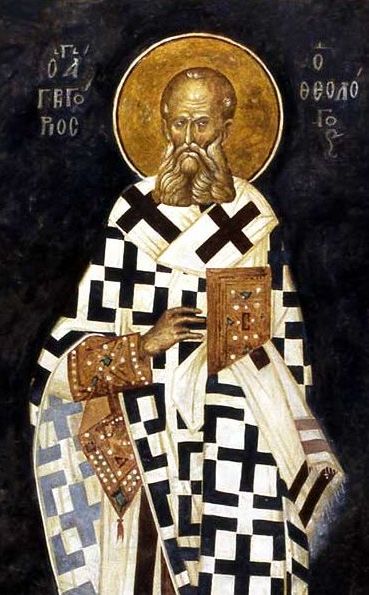
Gregory of Nazianzus on the Incarnation

Gregory of Nazianzus was a 4th century bishop from Cappadocia who eventually became the Archbishop of Constantinople. Together with the brothers Basil the Great and Gregory of Nyssa they were known as the Cappodocian Fathers. Basil, Nazianzus, and John Chrysostom are known collectively as the Three Holy Heirarchs, the Eastern Church’s version of the Four Great Doctors (Augustine, Ambrose, Gregory the Great, and Jerome). Gregory briefly presided over the Council of Constantinople (which gave us the Nicene Creed) and is responsible for the Trinitarian language we use about the Holy Spirit, the language of “three persons” (hypostases) of the Trinity, and in articulating Christology in the face of Apollinarianism. In other words, he was kind of a big deal.

It is to Gregory’s defense of the full humanity of Christ against the heresy of Apollinaris that I now turn. Apollinarianism was a heresy that taught that while Jesus had a human body, he did not possess a human mind. What’s the big deal, you ask? He’s still divine. Well, Gregory of Nazianzus would have none of that. In his Epistle 101 he eloquently articulates why it is important that Jesus Christ possesses a human mind. In this section he bequeaths to the church this important theological maxim that you should commit to memory: what has not been assumed has not been healed. Here’s the conclusion to his letter.

If anyone has put his trust in Him as a Man without a human mind, he is really bereft of mind, and quite unworthy of salvation. For that which He has not assumed He has not healed; but that which is united to His Godhead is also saved. If only half Adam fell, then that which Christ assumes and saves may be half also; but if the whole of his nature fell, it must be united to the whole nature of Him that was begotten, and so be saved as a whole. Let them not, then, begrudge us our complete salvation, or clothe the Saviour only with bones and nerves and the portraiture of humanity.

Gregory of Nazianzus, Epistle 101, 4th c. A.D.

Three things stick out from this quote. First of all is the Eastern notion that the incarnation itself, God uniting with humanity in the person of Jesus Christ, is the source of our salvation. Of course, the atoning work of the cross to gain the forgiveness of our sins was necessary, but this notion of the hypostatic union- that humanity and divinity are inseparably united together in Christ and by the very force of that union we find the source of the righting of our broken humanity- this is key aspect of our salvation as well. Thus, Gregory reasoned, if Christ was not fully human, we are not fully saved. If he did not have a human mind, as Apollinaris taught, then our minds are not healed. But if our minds are fallen, then we need our minds to be redeemed. Who among us who has suffered from depression, anxiety, or other disabilities that with modern science we know are afflictions of the mind would not agree that our minds are fallen and in need of healing? Since our minds are fallen we need a Jesus with a human mind, to heal our minds by the union of broken humanity with the divine.

Further, if our wills are fallen or our emotions, or any other non-tangible aspect of our inner-selves, then Jesus had to have a human one of those too. Otherwise we are not fully redeemed.

Secondly, we have in this quote something that looks an awful lot like the Calvinistic idea of radical depravity. Gregory’s syllogism requires belief in the notion that every aspect of humanity is fallen and in need of redemption. He writes, “If only half Adam fell, then that which Christ assumes and saves may be half also; but if the whole of his nature fell, it must be united to the whole nature of Him that was begotten, and so be saved as a whole.” The whole of his nature fell, including the parts that make decisions, the will, and enable a person to respond to the gospel call by faith. That looks like radical depravity to me.

And that leads to the third notion in the quote that so powerfully resonates: the idea that we are saved to the uttermost. It’s not just that our souls are rescued to escape eternal punishment. No, all of who we are, every aspect of who we are as humans is saved because every aspect of our fallen humanity was united to the Godhead in the person of Jesus Christ. In that humanity he perfectly obeyed and pleased the father, was crucified to pay the debt we could never repay, was raised again as the first-fruits of our resurrection, was glorified into a new incorruptible, impeccable humanity that we will all one day possess, and was raised into the heavens where a fully human person sits at the right hand of the Father ruling over all things and sustaining all things with his powerful word.

That is salvation. Do not begrudge us any little bit of it. For if any part of Jesus’ humanity wasn’t really human, if he wasn’t truly consubstantial with us in his humanity, then we aren’t completely saved. What has not been assumed has not been healed. Let them not, then, begrudge us our complete salvation, or clothe the Savior only with bones and nerves and the portraiture of humanity.