He Descended into Hell

At the church I pastor, New Life Ithaca, we say the Apostles’ Creed every week. I also say it a couple of more times a week when I pray the daily office. All told, I’ve recited the Apostles’ Creed thousands of times. 

I still remember the first time I said it. I grew up Pentecostal. We didn’t say creeds. I heard more than one preacher say, “No creed but Christ.” But that is itself a creed isn’t it? And we had a declaration of faith, which is a creed as well. But I digress.

The first time I ever said the Apostles’ Creed was at an African Methodist Episcopal Church. The mother of my high school friend Carl had tragically died at a young age and a group of us went to the funeral to support him. The funeral was a traditional liturgical service, as I know now, but very foreign to me then. As a part of the service we recited the Apostles’ Creed. I remember scrutinizing it in my head, especially the parts about believing in the catholic church and that Jesus descended into hell.

I’ve written quite a bit about Catholicity. But what of the descent clause? Did Jesus go to hell?

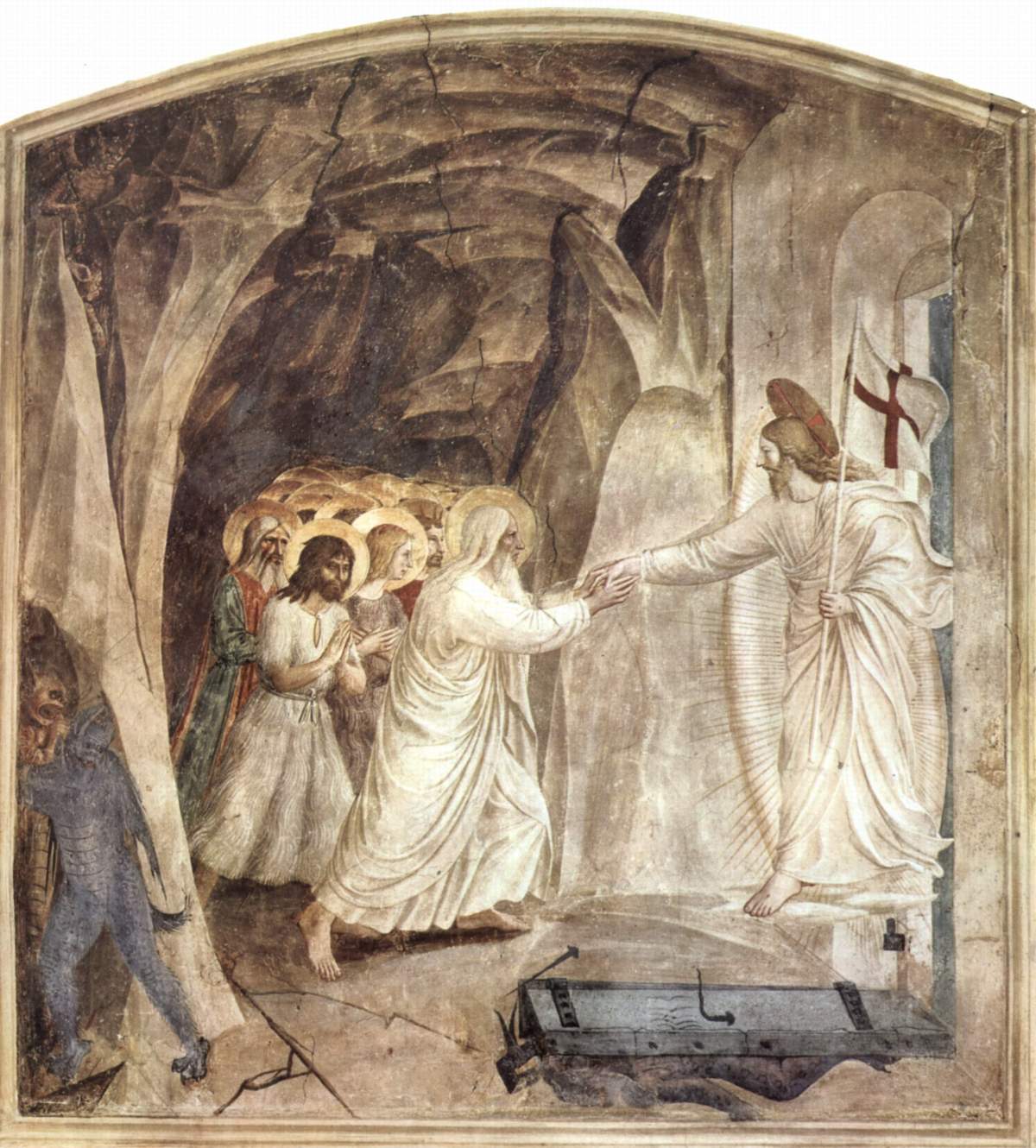
This Holy Saturday, I thought it appropriate to share a bit of what I’ve learned about this over the years. Holy Saturday commemorates the time between Jesus’ death and resurrection. It has historically been a time that emphasized rest and stillness. But at the same time, it has been seen as the time period when Jesus was “harrowing hell.” According to this ancient view, while Jesus’ body rested in the tomb, his spirit entered hell to declare his victory over Satan and to lead out the host of righteous dead from sheol/hades into heaven. We see in this ancient view, that Jesus did not enter the hell of fiery torment in order to suffer for our sins. He entered victoriously and “led a host of captives in his train.”[1]

While this harrowing of hell, or something like it, may have happened, the Bible does not explicitly say so. The only text that even mentions Holy Saturday is a half a verse at the end of Luke 23:56, “On the Sabbath they rested according to the commandment.” Psalm 68:18 and Ephesians 4:8 seem to allude to this harrowing, and some take Ephesians 4:9 to refer to Jesus’ descent into hell, the Latin even using a version of the word “inferno”.[2] Peter’s Pentecost sermon in Acts 2:27 and 2:31 also refer to Christ in hell, using the Greek word “hades” and the Latin word “inferno.” Further, 1 Peter 3:19 states that Christ preached to the spirits in prison. In context this refers to some declaration to the unrighteous regarding his lordship and victory. Psalm 107:16 and Zechariah 9:11 are also mentioned in support of this view as they seem to allude to Christ releasing captives from a deep pit.[3] But none of these explicitly say that Christ entered hell and plundered Satan on Holy Saturday. Again, it may have happened, and I tend to think that it did, but the Bible is not explicit about it.

The phrase in the Apostle’s Creed seems to be modeled after the Latin of Ephesians 4:9, but this is not certain. The Latin for this verse is, “descendit primum in inferiores partes terrae,” while the original Latin for the Apostles’ Creed is, “descendit ad infernos.” Notice that while the word “descended” is the same, the Vulgate uses the preposition “in” while the Creed uses “ad” and the Vulgate uses the word “inferiores” while the Creed uses “inferno”. These words are very similar, but not identical. 

For this reason there have been varying opinions of the meaning of the phrase “descendit at infernos” through the centuries. One view is based on what I’ve been describing, the harrowing of hell. This view was taught by several ancient fathers as well as medieval scholastics like Thomas Aquinas. Calvin’s view was that the phrase refers to the spiritual torment that Christ underwent on the cross (Institutes II:XVI:10). While this view is attractive, we have to admit that it is novel and not obvious from the Latin text of the creed. Luther’s view was that Christ literally entered into Hell, and many modern Lutherans share that view.

Calvin and later Berkhof point out that the phrase was included later on (Berkhof says that it appeared c. 390, which would date its appearance after even the creation of the Nicene Creed). Berkhof states that Christ could not have descended triumphantly into hell because his victorious resurrection hadn’t occurred yet and because that would contradict the period of rest that Christ’s statement “into your hands I commit my spirit,” implies. Berkhoff takes a view similar to Calvin’s, adding that the descent clause teaches the deepest humiliation of Christ in his death (Systematic Theology, 340-343). The Westminster Larger Catechism, question 50, takes a similar view, stating that the descent clause means that Christ truly died and remained under the power of death until the third day in his state of humiliation.

There is a marked difference between the Reformed view (Westminster and Berkhof) and the traditional view in that the traditional view presents Christ as already victorious while the Reformed view presents him still in a state of humiliation. The Reformed view has merit, as it asks the question, “How could Christ’s soul be victorious in hell while his body lay dead in humiliation?” I think that’s a valid question to raise.

Now to my view. My goal here is not to articulate another version or perhaps a synthesis of the above views, but to present a linguistic point. When we see the word “inferno” in the 21st century, we think of fire. That’s what the word means in English after all. So when we see the phrase, “He descended into hell,” we naturally think of the hell of fire. However, in the Latin usage of the time when the Creed was written the word inferno did not mean that yet. According to the standard Latin lexicon by Lewis and Short, the word meant, “underground, belonging to the Lower Regions.” Thus, “inferno” literally means “underworld”. What would be the biblical analog to this in Greek or Hebrew? It would be the Hebrew word “sheol,” or “place of the dead,” for which the Greek “hades” is used as a translation. None of these refer to a fiery place of the damned, but a place where even righteous souls rest when they die. 

OK, so why not say that then? Why not say, “He descended to the place of the dead?” Well, we are saying that. You see the word “hell” did not have the connotation of a fiery place of the damned until it gained an additional Christian meaning. The Germanic word “helle” simply meant the same as inferno: the underworld or place of the dead. You can see this in the Germanic word for paradise: Valhalla– “-halla” referring to the place of the dead.[4] Thus the English word “hell” in pre-Christian times meant just that: the place of the dead, with no connotation of fire or damnation. With this in mind, we really are saying, “he descended to the place of the dead” when we say “he descended to hell.” And what we mean by that is that Christ really died, i.e. his soul was separated from his body, and while his body lay in the tomb his soul visited the saints in sheol. 

As for the rest, whether he harrowed hell, proclaimed his victory to the damned, and led a host of captives out to heaven, there are scriptures that allude to this. But did it happen on Holy Saturday? I do not know. But I do know this. We will be able to ask him about it someday.


[1] Psalm 68:18 and Ephesians 4:8.

[2] But this translation relies on a dubious textual variant that Metzger, et al. rate as “C”, meaning the originality of the word “regions” is highly suspect and is more likely an explanatory gloss.

[3] John Calvin notes this and argues that Psalm 107 is referring to Israel’s captivity in Babylon and that Zechariah 9 is referencing a release from spiritual prison, Institutes II:XVI:9.

[4] See the entry for “hell” in the Oxford English Dictionary. That entry has a trove of information about the etymology and prior usage of the word. Significant is that in the earliest translations of the Bible into English, the Hebrew word “Sheol” was translated “hell,” meaning the place of the righteous dead.

The Biblical and Patristic Roots of the Church Calendar

Advent is Not Christmas, Part I

This is part one of a two part series. To read part two click here.

I have a pet peeve. Actually, I have several. This one has to do with the way that many churches do Advent, that is, as an extended time of Christmas. Their focus is on the first Advent of Christ, and the time is spent covering the biblical material leading up to his birth. Christmas carols and hymns are sung from the first Sunday of Advent onward and there is no distinctive Christmas season. In other words, Advent is Christmas.

There is just one problem. Advent is not Christmas.

Before I get any further I need to make several disclaimers. First, the purpose of this essay is not to shame anyone or call anyone out. I’ve observed this practice enough to not have any one particular church in mind. In fact, the church I attended this week on the First Sunday of Advent did it correctly. So, I’m not calling anyone out in particular and neither do I have any recent experience in mind. Second, my goal is not to cause anyone to feel ashamed or to cause any immediate, drastic changes in your church. My purpose is to educate and train. The church year is a secondary (or even tertiary) matter, and there’s no reason to go to war over how anyone does the church year (or doesn’t).

That said, if we are going to do the church year, I think that it ought to be grounded in what the Scripture teaches and what the church has observed over the centuries, and that as Reformed Christians we ought to have a good rationale and purpose for doing it.

In this essay, part one of two, I will cover the broader biblical and historical aspects and then in part two I will get into the nitty gritty of why Advent is not Christmas (and why that matters).

The Church Year is Grounded in God’s Word

The church year is not just a cool thing that trendy churches are now doing. While I think it’s good that all kinds of churches are getting in touch with the roots of historic Christianity, as we do that we need to understand what we are doing and why. Ancient does not necessarily equate to good and helpful, and we need to understand what unhelpful aspects may have developed in ancient practices so we can avoid them. When it comes to the church year, we are not just appropriating church tradition. It turns out that, as in many other things, the church’s tradition is grounded in God’s Word.

Please continue reading over at SemperRef.

Five Reasons Why the Ascension of Jesus Matters

Today the church celebrates the ascension of our Lord Jesus Christ into his glory in heaven, to sit at the right hand of God the Father and rule as King over the entire universe.

Why is that Christmas and Easter are such big deals in our culture, but Ascension and Pentecost are largely ignored? Have you ever thought about that? I think that the reason for this is that Christmas and Easter do not confront people with the lordship of Christ the way that his ascension does. Christmas is the easiest to accept for our culture. It’s just a sweet little baby born on a manger. Nothing there to confront me. Nothing there to make me take stock in my life. Even if we come to terms with the fact that this baby in the manger is actually God incarnate, it is still easy to sentimentalize and ignore. Baby Jesus. Sweet little Jesus. Tame Jesus.

Easter is a little harder to deal with, but we can manage it OK. Easter confronts us with the unmistakable fact that Jesus is who he said he is, the Son of the living God. Easter means we have to believe in Jesus, we have to believe that he is real and that he rose from the dead. This is why Easter has been made into cute bunnies, eggs, and pastel colors. These are not wrong, but they make Easter more palatable. Still, for those of us who embrace the real Easter, all it does it make us come to terms with the reality of Jesus. We must believe in him.

Yet when we come to the Ascension we are asked to do much more. We are asked not only to believe, but to take stock of our lives and to do what is right. The Ascension of Jesus means that Jesus is Lord. You are not lord. Your feelings are not lord. The government, the wealthy, the powerful, they are not lord. Jesus is Lord. This is the first of the Christian feasts that requires us to take stock of our lives and respond to the ever present reality of the lordship of Christ in our lives and over our world.

So what does the Ascension mean for us? Why does it matter? I want to look at five reasons why the ascension of Jesus Christ really matters to all of us in our daily lives.

1. The Dignity of Humanity
First, Jesus’ ascension into heaven means that all human life has great worth and dignity. This was so at the creation, where we read in Genesis 1 and 2 that men and women are created in the image and the likeness of God. That we are all created in the image of God means that we all have inherent worth. Look at the following from the 8th Psalm:

1 O LORD, our Lord, how majestic is your name in all the earth! You have set your glory above the heavens. 2 Out of the mouth of babies and infants, you have established strength because of your foes, to still the enemy and the avenger. 3 When I look at your heavens, the work of your fingers, the moon and the stars, which you have set in place, 4 what is man that you are mindful of him, and the son of man that you care for him?

The Psalmist begins by declaring the glory of God and wondering how man compares to God. Man is an insignificant ant compared to God. Right? This is the typical view of most cold, reformed types. Yet David does not stop there:

5 Yet you have made him a little lower than the heavenly beings and crowned him with glory and honor. 6 You have given him dominion over the works of your hands; you have put all things under his feet, 7 all sheep and oxen, and also the beasts of the field, 8 the birds of the heavens, and the fish of the sea, whatever passes along the paths of the seas. 9 O LORD, our Lord, how majestic is your name in all the earth! (Psalm 8:1-9 ESV)

We have great dignity because of our created humanity. We bear the image of God and have been given dominion over the entire earth. Each and every one of you has great worth because God has made it that way.

And the ascension of Christ means that this dignity and worth is fulfilled, cemented, and magnified. Jesus Christ is fully human and fully God. That means that a human being, a man, is now sitting in heaven and ruling the entire cosmos. Our humanity is raised and ascended with him! This magnifies the dignity and worth of all human beings. Our flesh is not something to be detested! Your bodies are not something to hate or abhor! Other races and nations of human beings are not in any way lesser than you or worthy of your subjugation! We all share a common humanity and that humanity has been raised up in Jesus Christ. Your bodies are beautiful. They are of great worth, because Jesus Christ has ascended. A human being with a real human body is the King of all. That means that all our flesh has been raised to this dignity. We are not to hate ourselves or hate other people. You have been raised up with Christ!

2. Access to God
Secondly, the ascension of Jesus Christ means we have access to God. The apostle Paul writes in Romans 5:

1 Therefore, since we have been justified by faith, we have peace with God through our Lord Jesus Christ. 2 Through him we have also obtained access by faith into this grace in which we stand, and we rejoice in hope of the glory of God. (Romans 5:1-2 ESV)

He also tells us in Ephesians 3:

8 To me, though I am the very least of all the saints, this grace was given, to preach to the Gentiles the unsearchable riches of Christ, 9 and to bring to light for everyone what is the plan of the mystery hidden for ages in God who created all things, 10 so that through the church the manifold wisdom of God might now be made known to the rulers and authorities in the heavenly places. 11 This was according to the eternal purpose that he has realized in Christ Jesus our Lord, 12 in whom we have boldness and access with confidence through our faith in him. (Ephesians 3:8-12 ESV)

So we see that we have access through Jesus to God the Father. We are told that we have bold access, that we are to go boldly to the throne of grace. But would that have been so if Christ had not ascended to heaven? NO! The reason we have access to God is because Christ Jesus ascended to heaven and he now sits at the right hand of the Father acting as an advocate for us. It is through Christ that we have access to the father. It is through the ascended Christ that we have bold access to him!

Furthermore, we don’t just have this flimsy ephemeral access to the Father. According to Paul in the letter to the Hebrews in chapter 4, WE ascend to heaven with Christ to enjoy access with the Father. It is through our worship each week that we are able to ascend to the Father and make our requests know of him:

Let us therefore strive to enter that rest, so that no one may fall by the same sort of disobedience. 12 For the word of God is living and active, sharper than any two-edged sword, piercing to the division of soul and of spirit, of joints and of marrow, and discerning the thoughts and intentions of the heart. 13 And no creature is hidden from his sight, but all are naked and exposed to the eyes of him to whom we must give account. 14 Since then we have a great high priest who has passed through the heavens, Jesus, the Son of God, let us hold fast our confession. 15 For we do not have a high priest who is unable to sympathize with our weaknesses, but one who in every respect has been tempted as we are, yet without sin. 16 Let us then with confidence draw near to the throne of grace, that we may receive mercy and find grace to help in time of need. (Hebrews 4:11-16 ESV)

How is it that we draw near to God? How is it that we draw near with confidence to the throne of grace? It is through our worship! It is by being consecrated by the living and active double edged sword of the word of God and by being raised up by the Spirit of Christ into the presence of the almighty. But we would not be able to do it without Christ,  without the ascended Christ. It is he who gives us access to the Father. It is because of the ascension of Jesus Christ that we can, each week, ascend into God’s presence to worship Him, petition Him, and feast on and be nourished by the body and blood of his Son Jesus Christ. If Christ had not ascended into heaven, we would have nothing.

Protestant Reformer John Calvin wrote:

“The Ascension means that heaven is not merely a hope, but a present possession for the Church in [Jesus Christ].”

Or as Paul writes in Ephesians 2:4-7:

But God, being rich in mercy, because of the great love with which he loved us, 5 even when we were dead in our trespasses, made us alive together with Christ–by grace you have been saved– 6 and raised us up with him and seated us with him in the heavenly places in Christ Jesus, 7 so that in the coming ages he might show the immeasurable riches of his grace in kindness toward us in Christ Jesus. (Ephesians 2:4-7 ESV)

You are raised up with Christ and seated in the heavenly places. You do this every week when we all gather together to worship God. Heaven is not merely a future hope, but a present possession for you, the Church, through Christ the ascended Lord.

3. The Ascendency of the Church
Thirdly we see that the ascension of Jesus Christ results in the ascendency of the Church. In Acts 1 we read of two men in white robes who address the disciples after they witnessed the ascension of Jesus:

“Men of Galilee, why do you stand looking into heaven?.” (Acts 1:11 ESV)

Why do you stare up into heaven? Jesus has ascended so that his Church can take up his work. So go, get to work! Jesus left them with these words:

But you will receive power when the Holy Spirit has come upon you, and you will be my witnesses in Jerusalem and in all Judea and Samaria, and to the end of the earth.” (Acts 1:8 ESV)

Which is Luke’s version of the great commission of Matthew 28:18-20:

And Jesus came and said to them, “All authority in heaven and on earth has been given to me. 19 Go therefore and make disciples of all nations, baptizing them in the name of the Father and of the Son and of the Holy Spirit, 20 teaching them to observe all that I have commanded you. And behold, I am with you always, to the end of the age.” (Matthew 28:18-20 ESV)

The ascension of Jesus therefore means that the work of the kingdom has been left for the church to accomplish. Have you ever thought about the fact that Jesus actually amassed very few devoted followers during his earthly ministry? In fact, as we from the ending of the gospel of Mark, Mark leaves no one left to boldly share the good news! Yet the ascension of Jesus means that Jesus himself is not going to take up that task. If Jesus had not ascended, if he had remained on earth as a king or religious leader, things would be drastically different. Have you ever wondered why he didn’t just stay? Why didn’t he stay? He tells us exactly why he didn’t stay. He went up because by doing so he enabled the church to become what it is today, a billion Holy Spirit filled Elishas who will be able to do far more than one earthly Jesus. Is that blasphemous to say? No, Jesus says, “You will do greater works than I.” The church is able to do more being empowered and filled with the Holy Spirit than one earthly Jesus could do. He left so that the church could also ascend. And our ascension means that we have work to do. We have his commission to fulfill. We, the church, are the hand of God in this world.

Paul says in Ephesians 4:8 (quoting Psalm 68): “Therefore it says, “When he ascended on high he led a host of captives, and he gave gifts to men.” The gift that the Lord Jesus gives to men as he ascends on high is his church. The apostles and prophets and evangelists and pastors and teachers are all gifts to the church, which in turn is a gift to all men. So let us go out and be a gift. Let’s live in a way as the church like we truly confess an ascended Lord and let’s be about his business in this world!

4. The Completion of the Atonement
Fourthly, the ascension of Jesus Christ is the completion of the atonement. We tend to think that the sacrifice of Jesus on the cross is the only necessary event of the atonement. Yet the Apostle Paul clearly says in 1 Corinthians 15:

And if Christ has not been raised, your faith is futile and you are still in your sins. 18 Then those also who have fallen asleep in Christ have perished. (1 Corinthians 15:17-18 ESV)

Thus, according to Paul, the atonement, the accomplishment of the forgiveness of your sins to make you right with God, was not completed on the cross, but that the resurrection of Christ was a necessary element of the atonement. Now, for certain, the sacrifice for sins was completed on the cross. The penalty that Jesus paid to God the Father was completed on the cross. Yet the complete atonement which makes you right with God was not complete. Jesus had to be raised. Paul says so. If Jesus had not been raised, you would still be dead in your sins.

Furthermore, the atonement was not complete until the ascension. The Apostle John wrote some verses that we repeat a lot here at Christ Our King. 1 John 1:8-10. Maybe you can say them by heart:

If we say we have no sin, we deceive ourselves, and the truth is not in us. 9 If we confess our sins, he is faithful and just to forgive us our sins and to cleanse us from all unrighteousness. 10 If we say we have not sinned, we make him a liar, and his word is not in us. (1 John 1:8-10 ESV)

We confess this because it says that if we confess our sins, the Lord forgives us. We claim that precious promise each week for the forgiveness of our sins. Yet do you know what the next verse is?

My little children, I am writing these things to you so that you may not sin. But if anyone does sin, we have an advocate with the Father, Jesus Christ the righteous. 2 He is the propitiation for our sins, and not for ours only but also for the sins of the whole world. (1 John 2:1-2 ESV)

The REASON why you can have forgiveness of sins, the reason why you can be right with God is because Jesus Christ has ascended into heaven, sits at the right hand of the father, and can constantly act as an advocate on our behalf. He has paid the penalty for our sins, he has been vindicated by God by being raised from the dead, and now he sits at his right hand constantly advocating on our behalf. There is no atonement, there is no forgiveness of sins without the ascension of Jesus Christ!

5. The Victory of Jesus
Finally, the ascension of Jesus Christ completes the Victory of Jesus Christ as the King of the entire Universe. Psalm 110:1 says:

The LORD says to my Lord: “Sit at my right hand, until I make your enemies your footstool.” (Psalm 110:1 ESV)

Peter uses this as his sermon text on the day of Pentecost, where he proclaimed:

This Jesus God raised up, and of that we all are witnesses. 33 Being therefore exalted at the right hand of God, and having received from the Father the promise of the Holy Spirit, he has poured out this that you yourselves are seeing and hearing. 34 For David did not ascend into the heavens, but he himself says, “‘The Lord said to my Lord, Sit at my right hand, 35 until I make your enemies your footstool.’ 36 Let all the house of Israel therefore know for certain that God has made him both Lord and Christ, this Jesus whom you crucified.” (Acts 2:32-36 ESV)

Jesus Christ is King of the entire universe. He is Lord of all. The US Government is not Lord. Jesus is Lord. The most powerful corporations are not Lord. Jesus is Lord. YOU are not Lord. Your feelings are not Lord. Your doubts and fears are not Lord. Jesus is Lord. This is why we can rejoice in our own weaknesses. This is why we can cast our cares on him. This is why we can boast in the Lord. This is why we are not to worry. This is why you can place your complete trust, in all areas of your life, in Jesus Christ, because HE IS LORD OF EVERYTHING.

Dutch Reformed theologian and leader Abraham Kuyper once said, “There is not a square inch in the whole domain of our human existence over which Christ, who is Sovereign over all, does not cry: ‘Mine!”

Jesus Christ is the victorious King, and he is Lord of all. He is Lord over your circumstances. He is Lord over your hurts. He is lord over your pain. He is lord over your uncertainties. He is lord over your fears. He is lord over your doubts. He is lord over your depression. He is lord over your families. He is lord over our city. He is Lord not just of the Church, but of every human institution. JESUS IS LORD!

He has defeated death. Death hath no more dominion over you. He has defeated hell. Hell no more be a worry for you. He has defeated the grave. The grave will not hold you. He has defeated the devil. The devil can do nothing to harm you. Jesus Christ has ascended into the highest heaven in the fullness of his humanity and his deity. He is a human man and he rules and reigns over all things.

Believe in him. Put your trust in him. And let him be Lord over your entire life and being. Hold nothing from him. Hide nothing from him. Keep nothing from him. He is Lord.

Visit our church website @ www.newlifeithaca.org.

Ecce homo: a Good Friday Homily

The Passion of Christ has long been a subject for artists. The material has depth of story  and emotion like nothing other. Some of the most beautiful art that has ever been produced has used the subject of Christ’s suffering and death as inspiration. In the world  of music there is the genre of the Passion chorale, in drama, the Passion play, and in art the standard canon of scenes from Jesus’ suffering and death as depicted in the Gospels.

One of those standard scenes in the passion canon is the Ecce homo. This scene gets its name from the famous words of Pontius Pilate as he introduces Jesus to the crowds after his flogging and humiliation. When he presents Jesus to the crowds, Pilate says, “Behold the man,” which in Latin is, “Ecce homo.”

Behold the man. Ecce homo.

This scene began to be a popular artistic subject in the late middle ages and into the Renaissance. Most of these depictions are shown in the third person, with you, the viewer back at an angle watching the entire scene unfold. The angry crowds are shown. The crowds who will call for Jesus’ death. The soldiers are shown, the torturer, the surrounding architecture and city are shown, and of course, Pilate and Jesus. Most of these paintings give the viewer a birds eye view of the entire scene to let you appreciate
the full gravity of this moment in all its awful enormity.

But there is one painting that is different, and it happens to be one of the most famous of this genre. In Caravaggio’s rendition, there are no crowds, no surrounding city, no buildings or architecture, there is nothing at all, but the torturer, Jesus, Pilate, and you.

Yes, Caravaggio’s brilliance is in placing we, the viewer, into the artistic moment. The painting is astounding in its simplicity. Christ is looking down, passively suffering, like a lamb before the slaughter. The torturer is almost gently placing a purple robe on the
shoulders of the suffering Christ. And Pilate, on whom the most attention is given, is standing in the foreground with his hands, palms upward, gesturing toward Christ, his body pointing neither at Christ or us, but his head turned and looking us squarely in the eyes. In Caravaggio’s work Pilate is taking a neutral stance. He is not for or against Jesus. He is almost indifferent. And he looks to us almost as if to say, “What do you
want me to do with him? It is up to you. Behold the man.”

Now, this was revolutionary because the depictions of Ecce homo that preceded  Caravaggio serve to make you empathize with the suffering Christ and to be angry with those who caused his suffering. The torturer is shown with an insane look in his eyes. The soldiers are blood thirsty. The crowds are enraged. You are supposed to be angry at  them. But in Caravaggio’s painting, the torturer almost doesn’t even want to be there, Pilate seems indifferent and annoyed, and the only person to blame for the horrible state of Christ’s suffering and humiliation is the only other person left in the artistic moment: me.

I think Caravaggio gets it right. You see, Pilate is not saying Ecce homo to the scribes, the Pharisees, the chief priests and rulers of Israel. Pilate is saying Ecce homo to you, to me. He is saying to us, “behold the man.” Pilate is asking us what we will do with this Christ, this King of the Jews. He is saying to us, “Behold the man.” Behold him. Behold this Christ.

There is something about considering Christ in this specific moment, almost as if we had hit pause on our TV remote. Here is Christ. Before he dies on the cross, yet in the midst of his suffering and rejection. This is a part of Christ’s passion, you see. This is a part of his atonement. He had to experience this moment. Behold the man.

Behold him as he is scourged. There are two Greek words used in the gospels that
describe the scourging of Jesus. One word emphasizes the many pronged whip that was used, with bones and metal tied to the tips of the leather thongs. These thongs sliced through his flesh. The other word used in the gospels is the word that we get our word for “to chew” and emphasizes how the whip tore and chewed through his flesh. This scourging was for the purposes of torture, and the Romans were very good at it. Its goal was to inflict excruciating pain but still leave the subject alive so that he could be crucified. If this scourging itself would not have been limited, that act itself would have killed him. Behold the man.

Behold him as the Roman soldiers take thorns and twist them and make them into a crown of mockery. Behold him as they cruelly force the thorny crown onto his brow. Behold the blood as it begins to pour. Behold the man.

Behold him as the soldiers mock him and strike him. Behold him as they take a purple robe and place it on him, mocking his supposed kingship. Behold him as he is mocked and beaten by the very ones whom he carefully and wonderfully knitted together in their mothers’ wombs. Behold the man.

Behold him now as he is brought out again before you. Behold him as Pilate presents him to you again. Behold him stricken, smitten, and afflicted. Behold the sacred head now wounded, with grief and shame weighed down. Behold him despised and rejected. Behold him acquainted with grief. Behold the man.

You want to look away, don’t you. We can’t bear to look, can we? It is too awful, too gruesome. But ultimately, we are too ashamed. We cannot look because we know that
it is our sin that put him there. We cannot look because it is our penalty that he is suffering to pay. We cannot look because it is we who have condemned him. Yes, when Pilate looks at us and says, “Behold the man,” we would like to think that we would grant him reprieve. We would like to think that we would take Barabbas instead. But no one has ever taken Barabbas. We have all taken Jesus. We have all condemned him to die.

When did we do this? Every time we sin. Every time we reject goodness of the creator for our own selfish ways. Every time we follow the wicked ways of this world instead of the ways of God we are asking for Barabbas and rejecting Jesus. Every time we harden our hearts and do what we know is wrong, we are saying, “Away with him! Away with him! Crucify him! Crucify him!” Behold the man.

Tonight, we are all faced with a choice. Pilate looks at us and asks us a question, “What will you do with this Christ?” The beauty of the gospel is that you can make this choice anew tonight. All past wrongs can be forgiven if you will choose Christ again. Be sorry for your sins! Repent and turn away from them. Choose Christ and send away your own sinful flesh. He suffered and died to make this way for you. He paid the debt that you
owe. He suffered the wrath that you deserve for your sins. Choose Christ and nothing else! Run to Christ and receive his grace! Bask in his mercy that he bought with his
own blood. Be healed with the stripes of his back. Be renewed with the blood of his brow.

What will you do? What will you choose? This the most important decision you will ever make. Will you choose Christ, or will you choose to continue to wallow in your sin and misery? Will you choose Christ or will you choose death? There is no need for you to die because Christ has died so that you all might live. Choose life. Choose Christ.

What will you choose?

Behold the man.

“Easter” is not a bad word

It is once again the time of year that folks begin to ramp up for Easter. Easter bunnies, Easter egg hunts, and other various trappings are beginning to be ubiquitous. Now, I will be the first to recognize that the secular (and especially corporate) focus on fluffy bunnies, eggs, and the like is an attempt to sterilize the explicit Christian content of Easter, specifically that of the resurrection of Jesus from the dead. Yet, I would also argue that Christians who wish to push back against that sterilized (if not secularized) view should not abandon these traditional symbols of Easter, but should fully embrace them and refill them with their Christian meaning.

The same can be said of Christmas. The traditional symbols of Christmas- St. Nick, trees, gifts, feasts- may have been sterilized, secularized, commercialized, and paganized, but that does not change the fact that St. Nick is a real Christian saint, that the Wise Men really offered gifts to the baby Jesus, and that trees and feasts also have their origin in biblical theology. No more should we as Christians abandon these symbols of Christmas than we should abandon the traditional symbols of Easter.

Yet, while I have asserted that the traditional symbols for Easter, including the word “Easter” itself, are Christian in origin, I have not yet substantiated that claim. What is my claim exactly? Well you may have heard that the word “Easter” is of German pagan origin. As a result we Christians sometimes get a little uneasy about using that word. In this post I set out to argue that the word “Easter” is not of pagan origins, and that the word “Easter” itself is actually a Christian metonym for the word “resurrection.”

What is a metonym exactly?  A metonym is a word-symbol that represents another more abstract word that can be used in place of that word. For example, a scepter is something that a king or queen might hold as a symbol of their authority. Yet the word “scepter” itself can be used as a metonym for the word “authority.” In other words “holding the scepter,” can mean “possessing authority.” This is like when Jacob prophesies that the scepter will not pass from the hand of Judah in Genesis 49. There, the word “scepter” is a metonym for kingship or rule. Another way to think of it is that a metonym is a metaphorical or symbolical kind of synonym.

So the word “Easter” is a metonym for “resurrection.” Now, where do I get that? Well, from none other than the Oxford English Dictionary (OED), widely considered to be the definitive record of the English language. Now, as far as lexicographical philosophies go, the OED is descriptive and not prescriptive. In other words, what  the OED sets out to do, in an academically rigorous fashion, is to describe the various usages of a word throughout the history of the English language. This is opposed to prescriptive lexicography, which is the notion that a dictionary should impose its view of language on others. As opposed to stating how a word should be used, rather, descriptive lexicography presents how words have been used already.

Now where I find the OED supremely helpful is in its record of word origins and etymologies. If we look to the entry for “Easter,” what we find in the etymological section is that the word is not of pagan German origin, but of Greek origin. What we find is that far back into our linguistic heritage (that would be the Indo-European family of languages) the word “east” has been a metonym for the rising of the Sun or the coming of the dawn. Thus the Old Dutch ōster, the Old Saxon ōstarthe Middle Low German ōsteren, or the Northumbrian Eostre, never found their origins in any pagan festival, but in the fact that the Sun rises in the East (der Osten is German for “the East”). Thus East(er) means dawn, or the rising of the Sun. This word “Easter” became associated metonymically with the vernal equinox in Germanic lands, and subsequently after their acceptance of Christ, the same word became metonymically associated with the Christian festival of the resurrection of our Lord.

Now the fact that Jesus rose from the dead at or near the vernal equinox is no coincidence. The vernal equinox has always been associated as the creation of the world (in the Hebrew conception), and Jesus is considered to have both been conceived and to have died at or near the vernal equinox, coinciding with the creation of the world and the Hebrew deliverance from Egypt (this is why the Introit for Easter Sunday is the Song of Moses from Exodus 15). Thus a new world comes into being through the resurrection of Christ at the same time of year that the world itself is growing in light (in the Northern Hemisphere) and at the exact point when that light begins to over take the darkness (which by the way is why Easter can never be before the vernal equinox, before the point of the year when light overtakes darkness).

Now, reader, you may also note that only German and English speakers call Easter “Easter,” while the rest of the world calls the festival “Pascha,” which is Greek for “the Passover.” Well let us ponder this for a moment. Germans and English live in much more Northern latitudes than do Greeks or Latins. Do you think that perhaps in the German mind, where the darkness of winter is so much more pronounced than in more southerly latitudes, the coming of the spring might so much more be associated with the resurrection of our Lord? In the most Northern parts of Europe, darkness nearly overtakes the day completely in the depths of winter. Easter then is the day when light finally has defeated the dark. For Greeks and Latins this astronomical reality is not so much of a big deal because they never experienced the disparity between light and dark during winter to the degree that the Germans did.

So, where did this misconception about Easter being pagan come from? The fact of the matter is that there is only one source in existence that claims that the word has such an origin. Now that this source is quite venerable (literally, in fact) explains the stubbornness of this myth. Sadly, it comes from one of my heroes of the faith, the Venerable Bede, the Northumbrian Saint, who while otherwise a very respectable scholar and theologian mentions in one place while talking about the origin of their word for the month April that the word Eostre comes from the celebration of a pagan godess. While Bede is quite the authority on most matters, there is no other source to collaborate this claim, and the OED states that this etymological claim is “less likely” (which is academic speak for not holding much water), and that some scholars think that Bede may have made the whole thing up (for what reason we cannot guess).

If we think about this logically we may suppose that there may have been a pagan feast for the coming of spring, and if so why wouldn’t there have been? Wouldn’t you celebrate the ending of the long dark winter if you lived in Northern Europe? Yet, the word Easter is not pagan in origin, but an ancient way of referring to the rising of the Sun and the coming of spring.

Besides, feasting is biblical in origin, so it is ever as much likely that the pagans started having a springtime feast in response to the Christian festival of the resurrection of our Lord.

So, don’t be afraid of the word Easter. Gladly and loudly go about wishing everyone a “Happy Easter!” this Sunday without reservation. Because Easter is not a bad word.

And when you Fast

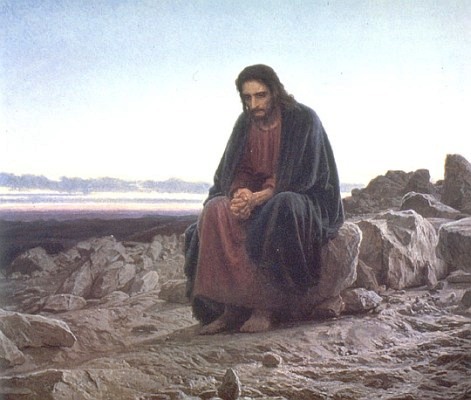
Christ in the Wilderness- Ivan Kramskoy- 1872

This is part three of a series on Lent. Part one: On the Origins of Lent; Part two: The History of Lenten Fasting.

Fasting is a biblical practice. In the sermon on the mount Jesus denounces the false fasts of the Pharisees, yet he assumes that fasting will nevertheless be a part of the Christian life. Twice in Matthew 6:16,17 Jesus says, “When you fast.” That Christians should fast is assumed by our Lord.

Despite this clear biblical teaching, while I’ve heard a great deal from Reformed teachers concerning when we shouldn’t fast and what fasting isn’t about, I’ve heard scarcely little written in a positive fashion about when and how we should fast. Now, what the recent teaching on fasting has done well is to offer a corrective to the idea that fasting is some sort of spiritual discipline. Fasting is not a spiritual discipline. In the Bible, fasting is always accompanied by prayer and is done for a specific purpose. Just do a simple word search and see for yourself.

Yet while we have had this needed corrective to the concept of fasting, we have not yet replaced it with a helpful, positive view of what fasting should be. This is what I want to explore for a bit in this article. Secondly, I want to explore whether this new reformed kind of fasting has a place in Lent.

What then is fasting for, and when should we do it? In the Bible people always fast for a specific purpose, and fasting is always coupled with prayer. Therefore, you never find a person in the Scriptures fasting as a general spiritual discipline (except the Pharisees). There is always a reason for the fast. People in the Bible fasted when they wanted an answer to prayer.

Furthermore, there is a strong connection in the Bible between fasting, mourning, and repentance. I will give two examples of this from the book of Samuel. In 1 Samuel 7, the people were oppressed by the Philistines and longed for deliverance. Samuel, now Judge of Israel, calls the people to put away their idols and repent of their sins so that Yahweh will deliver them. The people then respond to Samuel by obeying his word, and then in verse 6 we find that they fast and pray as a sign of repentance and to ask Yahweh to deliver them, “So they gathered at Mizpah and drew water and poured it out before the LORD and fasted on that day and said there, “We have sinned against the LORD.” And Samuel judged the people of Israel at Mizpah.” So the people fasted as a sign of repentance and the Lord delivered them from the Philistines.

Another example of this is from the life of David in 2 Samuel 12. After David commits adultery with Bathsheba and is called out for his sin, he repents of it. Still, as a result of David’s fall, Nathan says that Yahweh is going to take his first son by her. When the child becomes sick (the text says that Yahweh afflicted the child) we find this in 12:16, ” David therefore sought God on behalf of the child. And David fasted and went in and lay all night on the ground.” Again, we find that fasting is coupled with mourning, repentance, and a request for deliverance.

Example after example from the Scriptures can be brought forth in support of this general idea (see Nehemiah 9 and Joel 2 for two other examples). What the biblical data shows us is that we fast when we are in a very serious situation. We fast when we are mourning and asking for deliverance. We fast when we are  penitent. We fast as a physical manifestation of our urgency in crying out to God to hear and answer us in our time of need.

The criticism of fasting in the Bible that we find from Jesus and the prophets is not that it is a bad practice, but the criticism is that it is not done in a sincere way. The Old Testament reading for Ash Wednesday in the Book of Common Prayer is Isaiah 58:1-12. In that text the fasting is performed in an outward but insincere way. The text continues that fasting must be coupled with acts of righteousness. It must be accompanied by true contrition and true faith. Outward acts alone are not enough, but they must flow from the inward condition of the heart.

Given this, should a Christian undertake regular times of fasting, or should it be irregular and infrequent? Ask yourself: is the church called to sacrifice itself for the life of the world? Do we take seriously our call to die to self? Is it just when circumstances in my own life are bad that I should mourn and fast, or should I, we, the Church, fast and mourn on behalf of our broken, fallen world, our friends and neighbors, asking for our God to deliver it from evil and for His Kingdom to come? Do we not see enough reasons around us to fast and mourn for the deliverance of our city? Our nation? Our world? Do we have our eyes open?

Perhaps we should view fasting as a type of memorial like the Lord’s Supper, though to a lesser degree. In the Scriptures a memorial is something that primarily serves to remind God, and only secondarily serves to remind us. A good example of his is the rainbow. In Genesis 9:13-15, God tells Noah that he will set the rainbow in the clouds to be a reminder to Him, and that when God sees it, God will remember his covenant with the creation not to ever destroy it again by a flood. Of course, since the rainbow is a physical sign that we can also see, we are also reminded of God’s promise when we see it, yet it is primarily to remind God. In the same way, the Lord’s Supper is a memorial, and when we celebrate the Lord’s Supper we are primarily reminding God of his covenant promises to us, and only secondarily reminding ourselves of Christ’s death on our behalf. Nevertheless, the two, God’s remembering and our remembering, are inseparable.

In the same way, the Bible also speaks of prayer as a memorial. One clear example in Acts 10:6 where God appears in a vision to Cornelius the gentile and tells him that his prayers and his alms have ascended as a memorial before God (see also Acts 10:31). As a result, Cornelius is to send for Peter who will preach the gospel to him and his household. As we know, Peter comes, he preaches the gospel, and the Holy Spirit falls on the gentiles assembled there as He did at Pentecost. Then Peter baptizes all of them.

Now my point in mentioning this is that twice in this account by Luke, in verse 6 and in verse 31, prayer is called a memorial, and it is clearly a memorial that reminds God. In the same way we can see fasting as intensified prayer and that fasting too is a kind of memorial, a sacrificial offering that ascends to the Lord and gets his attention. Now, this may raise our hyper-calvinist hackles, but this is the way the Bible speaks.

Therefore if prayer is a memorial and fasting is an intensified type of memorial prayer, then  we can see why the church would want to enter into regular periods of prayer and fasting for the sake of the broken world around us. We are called as the church to take up our crosses, deny ourselves, and follow Jesus: follow Jesus into the wilderness; follow him as he gives his life for the life of the world. Lenten fasting is one small way in which we follow Christ by offering up our memorial before the face of God, asking him to act on our behalf.

Therefore what are we fasting and praying for in Lent? We are mourning and fasting because of our own sins. We are acknowledging our part in the broken condition in this world, and we are calling on God to act in our lives to heal us of our own sinfulness and to help us to lead lives of righteousness. Furthermore, we are fasting and praying for the life of the world. We are crying out to God to come and fix our broken world, and we are denying ourselves as a memorial before his face that he will act to strike down evil and cause his kingdom to come in evermore increasing ways in this world. In this way, Lenten fasting is a sacrificial act by the church on behalf of our world. Through it we are crying out to God to fix all the brokenness and pain we see around us: all the death, the sin, the wickedness, the injustice, the poverty, the disease, the war, the infertility, the loss, the hurt, the loneliness – every single way in which this world is fallen and broken – we are crying out to God to heal, to save, to deliver.

So, you see, we do have reasons to fast during Lent. We have good biblical and theological reasons for our fasting and abstinence. Through our fasting we are acting as living sacrifices, living memorial stones, asking God to heal our world, a world that we can surely seen is in desperate need of His healing touch.

This is part three of a series on Lent. Part one: On the Origins of Lent; Part two: The History of Lenten Fasting.

The Significance of Anointing in the Bible

In Luke 4:18 Jesus claims that he has been anointed a Messianic Prophet:

 “The Spirit of the Lord is upon me, because he has anointed me to proclaim good news to the poor. He has sent me to proclaim liberty to the captives and recovering of sight to the blind, to set at liberty those who are oppressed, (Luke 4:18 ESV)

What does it mean to be anointed, and why was Jesus anointed? Well, both the Greek and Hebrew words used in the Bible for anointing literally mean “to smear oil on something.” Yet the question arises, what does smearing oil on something have to do with preparing one for ministry? In the Bible we know that priests, kings, and prophets were all anointed. What is it about rubbing or smearing oil on someone that is beneficial for these tasks?

If we study ancient near eastern bathing practices we find that oil had a prominent place in bathing. Oil was used like we use soap, to aid the water in the cleaning process. Also, oil was used after the bath in order to protect the skin against the harsh arid climates surrounding the Mediterranean.  We see evidence for this in the Bible in 2 Sam. 12:20. Therefore we see that oil aides the water and oil protects the body.

What else does oil do? We also find in the Scriptures in Psalm 104:15 that oil makes the face shine. Shining faces speak of glory. When Moses went in to speak with God, he had a shining face. So rubbing oil on the head and face makes one glorious.

What else? We also find in the Scriptures and in other ancient sources that the weapons of warriors, and even the warriors themselves would be anointed with oil for battle. The purpose is unclear, but it seems to have served a protective purpose. Thus we see that anointing is for cleansing and protection, to aid in battle, and to give one a glorious shine.

Yet Jesus stands up in the synagogue and says: “The Spirit of the Lord has anointed me.” Now this removes the physical oil completely from the equation and reduces the anointing to its spiritual significance. Yet we must not forget what an anointing with oil does: it cleanses, it protects, it makes ready for battle, and it glorifies. Here we see that the spiritual reality of an anointing is the pouring out of the Holy Spirit. Specifically, this anointing which Jesus is proclaiming about himself occurred at his baptism, where he was washed with water, and the oil of the Spirit aided the baptism and was applied to Jesus in conjunction with the water. After His baptism, Jesus is now the Messiah, the Anointed One, and he is cleansed, protected, glorified, and made ready for his new ministry (battle) that is before him.

Maybe you bristled just now when I said that Jesus was cleansed by his baptism and his anointing. “Wait a second,” you say, “ wasn’t Jesus perfectly sinless? Why then did he need to be cleansed?” Well, I agree that Jesus was perfectly sinless. Yet he was made incarnate into our own fallen human flesh. It wasn’t his own sin for which he needed to be cleansed, but for the sins of all of us. Jesus was baptized for us so that we could follow him through the waters of baptism into the new creation that he is bringing into the world. The cleansing of his baptism and anointing, therefore, cleansed our fallen humanity and readied it to be able to “pass through the heavens,” (Heb. 4:14) to sit at the right hand of God as the Ruler and Judge of the entire cosmos.

A Biblical Theology of Maturation and Renewal

The apostle Paul tells us in 2 Corinthians 3:18 that, “we all, with unveiled face, beholding the glory of the Lord, are being transformed into the same image from one degree of glory to another.” How is it then that the Spirit is transforming us from glory to glory?

The pattern of maturation in the scriptures is a progression from priest to king to prophet. The priestly phase is a propaedeutic phase of keeping rules and doing things exactly according to the book. This corresponds to our childhood which is full of rules. The kingly phase is a phase of ruling and exercising dominion in the vocation that God has given us. This corresponds to the main phase of our adult life. The prophetic phase is a phase of increasing influence and wisdom based on a lifetime of knowledge and experience. This phase corresponds to  our “golden years” which all to often in our culture are discounted by the younger generation. Biblically speaking, the prophetic phase is the most glorious and most influential, though we tend to value the kingly phase the most in our culture.

The bible also shows us that moving from glory to glory is preceded by a time of testing. The first test is the wilderness trial, where the person must deal with the Heavenly Father and come to terms with their personal loyalty to him. This trial is shown in Israel’s wilderness wandering as well as Jesus’ 40 day temptation in the wilderness. At the end of the wilderness trial, Joshua says, “Choose you this day whom you will serve,” (Joshua 24:15). Passing this test makes one ready to become a priest, where performance is measured by doing exactly what God says, and blessings/curses are meted out accordingly.

The second test is the garden trial. The garden trial is a test to see if one is willing to lay down his life for others, specifically his bride. The garden trial is shown in the scriptures in Adam’s test by the serpent in the garden as well as Jesus’ temptation in Gethsemane. Being willing to lay down one’s life for the sake of others is the test that is required to move into the kingly phase of life and ministry, which requires exactly that one lays down one’s life on behalf of those which he (or she) has been given to rule. The kingly phase is marked by wisdom, and the exactness of the rules of the priestly period are stretched (and sometimes broken) according to the wise rule of the king.

The third test is the fiery trial. The fiery trial is a test to see if one will pass on the kingly rule and all the things which one has built to the younger generation of junior kings. The fiery trial is shown in the bible in several places: Abraham’s sacrifice of Isaac, Elijah’s handing down his ministry to Elisha, and Jesus sending the Holy Spirit to his church on Pentecost. Passing the fiery trial (which involves both being willing to let go of our “sons” as well as passing our ministries down to them) makes one ready to become a prophet. Being a prophet in the bible is the most glorious and the most influential. Where the king is taken up with the day-to-day aspects of ruling, and his influence is largely over those he rules, the prophet has time to spend influencing and impacting the greater world. Prophets in the bible are world changers. They usher in new covenants and phases of redemptive history. They have power to rebuke and instruct the nations of the world, not just the local Israel. Being a prophet means one has remained faithful through the three major tests of life, and that one has gained a treasure trove of wisdom and knowledge based on his life experiences, knowledge of the scriptures, and close connection with God. Prophets should always be listened to, and never discounted in the church.

For the most part we as Americans are good at getting to the kingly phase, but we stall before getting to the prophetic phase. How can we do a better job of passing the fiery trial and becoming world changers? Kings have power and influence, but prophets make kings and disciple the nations. This is the phase that we must most aspire to, and must value the most in our churches.