
“I Hate Christmas.”
I once read an article in the Washington Post whose title was, “I hate Christmas.” It wasn’t entirely what I expected: an atheist curmudgeon annoyed by the ubiquitous seasonal Christian messaging, wishing that everyone would get off his god-free lawn. While there was a little bit of that in the piece, it was mostly centered around the fact that because the author grew up poor, he could never experience Christmas the way movies, tv shows, pop songs, commercials, catalogs, and even friends and family taught him he was supposed to experience it. His family could never afford the lavish feast, the tree surrounded with all the items on his Christmas wish list, or even a very nice tree. He now shuns Christmas along with its gatherings, festivities, gifts, and cheer, instead spending all the money he can afford buying toys for poor children so they can have the Christmas he never had.
I finished the article thinking that the author hadn’t rejected Christmas, he had rejected what Christmas has become: a commercialized cornucopia of instant gratification. What he had actually offered was a valid critique of Christmas and a call to recenter on its true meaning. After all, what more pure symbol of the Christmas spirit is there than sacrificing financially to provide gifts to poor children? St. Nicholas, anyone?
Afterward, I perused a bit of the comment section (yes, I know you are not supposed to read the comments). Many commenters agreed with the author. Some agreed because they were of other religions or were atheists (what I thought the article was going to be about). Others, though, didn’t reject Christmas but rather the spectacle that it has become. One commenter replied, “Only 2-ish weeks before the schizophrenia is behind us. My favorite day of the year is January 1, when it’s all over.”
Christmas Isn’t the Problem
Now don’t get me wrong, I love Christmas. If there was a hidden camera in my house it would catch me randomly singing, “It’s the most wonderful time of the year!” My wife and I have curated the biggest (and best) Christmas display in a three or four block radius (in our estimation… opinions may vary). I love the feasting. I love the gift-giving. I love the Christmas liturgies, hymns, and candlelight services. I love all that because I love the message of Christ born to set his people free. I love the message of Immanuel, God-with-us, that the God of the Universe took on every bit of our broken humanity so that he could redeem it all. I love it because the incarnation is the only sufficient answer to the problem of evil in this world, as the best philosophers have realized, St. Augustine at the head. I love it because he became sin, who knew no sin, that we might become the righteousness of God. That’s the reason I’m singing, “It’s the most wonderful time of the year!” That’s the reason why I’ve lit my yard up in multicolored c-9 ceramic bulb nostalgic glory. That’s also the reason why I’m ecstatic that the whole world pauses once a year to celebrate the fact that God was born into the world.
And yet, I resonate with what that Washington Post author wrote. Because he’s right. The Christmas message is not what Hallmark, Home Depot, Honda, Hanes, Harley-Davidson, Hurley, and Hasbro are selling us. We have gotten off the rails, or jumped the shark, or whatever metaphor you want to use, in our overindulgence of the Coca-Cola commercialized version of Christmas. The songs, ads, and store displays start before Halloween now. That’s three full months on a peppermint Red Bull IV drip of wall-to-wall Christmas experience. There’s no expectation. There’s no preparation. There’s no self-denial. It’s just CHRISTMAS!!!!!, full-bore, full-tilt for three full months until December 26 when they turn off the spigot and we collapse into full-on exhaustion. No wonder some people hate it.
But that’s not the way Christmas was designed by those that developed the church year centuries ago. Yes, there was feasting. Yes, there was decorating and singing and gift-giving. But preceding it was a period of longing, expectation, and self-denial focused on something entirely un-Christmassy: the second coming of Christ. In other words, there was the season of Advent. And Advent was not Christmas.
Perhaps refocusing on the wisdom of those that created the autumnal portion of the Church calendar could help us in our current predicament. What can we learn by sitting at their feet?
The Creation of the Christmas Season
The Advent/Christmas cycle of the church year is a creation of the church itself. This is an important point to note, especially for Protestants. In part one I argued that the springtime cycle of the church year has biblical and patristic roots. Because of those clear biblical roots and direct one-to-one correspondence between Passover/Easter and Pentecost, those two feasts have always been celebrated by the Church from its earliest days. In fact, the only question about early observance of the Spring calendar was when Easter would be each year. To be fair, Lent was a creation of the early church, but its antiquity far outstretches that of Advent and Christmas. Lent, or something like Lent, has been a part of the church from at least the second century A.D.
However, when we come to the fall cycle of the church year, though we do have a clear mandate for a Fall festal calendar, we do not have a clear one-to-one correspondence of OT feasts to NT ones. For that reason, it took a few centuries for unanimity on the fall calendar to develop. I want to briefly trace that development and the reasons for it.
The first part of the season to develop was Christmas Day. The origins of Christmas are a bit murky when compared to Easter, but there are some clear historical markers. The first thing to note is that Christmas was not an appropriation of the Roman feast of Sol Invictus (the Unconquered Sun). First of all, that was not an ancient Roman feast, having been created in 274 by the Emperor Aurelian in a political effort to spark belief in the re-birth of the Western Roman Empire that was crumbling under his feet. It makes no sense for Christians to have appropriated a recently created Roman feast that had no popular following. Sol Invictus is a historical artifact, nothing more. However, Christmas is of Roman/North African origin, and there is some evidence, from no less than St. Augustine, that the celebration of Christmas in North Africa predates the Donatist schism. That would place observance of December 25 as the Feast of the Nativity well before Emperor Aurelian’s creation of Sol Invictus and suggest that the emperor was instead responding to the threat of Christianity by choosing that date.
Why then December 25th? What we need to understand is that the selection of exact days of the year when things occurred was not an essential quality of the church calendar. As I covered in part one, the essential quality of the church calendar was to create a yearly festal calendar for the New Covenant church based around the events of the life of Christ. We do not know when Christ was born, though some have made the case that it was exactly on December 25, and it may have been. However, dates were selected based on their significance in relation to the created year (see part one on day four of creation). We need to think of the church year not as historical reenactment, but as a yearly sermon series. Its purposes are for discipleship, not for reliving the historical record.
So why December 25th? The reason, it seems, is based on two notions. First is the ancient Jewish idea that the prophets and patriarchs were born or conceived on the same day that they died. Second, was the apparent Patristic conviction that major events in salvation history should align with the Solar calendar, and thus fall on a solstice or equinox. Both of these notions led to the idea that the best placement for Christ’s conception was on March 25th, which happens to be when the church commemorates the Annunciation (Luke 1:26-38), and thus his nativity was placed nine months later on December 25th. Whether or not these are the exact days on which these events occurred is largely irrelevant for the purposes of the church year. The point is that these texts are read and taught on those days and their significance in salvation history is celebrated. A church could choose to read the texts surrounding Christ’s birth in July and celebrate it then. As I said in part one, the calendar is a matter of adiaphora. However, if a church did that, that church would not be in step with the rest of the church throughout the world. If catholicity has any value, then keeping the calendar of the universal church should have some weight. As St. Athanasius once wrote concerning the observance of Lent, “while all the world is fasting, we who are in Egypt should not become a laughing-stock, as the only people who do not fast, but take our pleasure in those days… exhort and teach them to fast forty days. For it is even a disgrace that when all the world does this, those alone who are in Egypt, instead of fasting, should find their pleasure.” The early church certainly took their liturgical unity very seriously. Indeed, it was one of the main reasons the Council of Nicaea was convened.
Christmas to Advent
By the late fourth century the celebration of the Nativity was universally accepted, in East and West, on December 25th. In a compromise to earlier Eastern traditions of celebrating the day on January 6th, the Feast of Epiphany was accepted in the West around the same time. In this conception the liturgical year then began on December 25th and there was no preceding season.
Over time a preparatory season developed in the Western Church. It seems to result from areas, like Spain and Gaul, who were more influenced by the East. In the East, Epiphany is a major occasion for baptism, second only to Easter. In fact, to this day, some Eastern traditions will do a kind of “polar bear plunge” on Epiphany as they mark the baptism of our Lord. In Spain and Gaul it was understood that if baptisms were going to occur on Epiphany, there ought to be a corresponding preparatory fast akin to the one that preceded Easter. In fact, Lent as a fast has its origins as a preparatory fast for those who would be baptized on Easter Sunday, and gradually that practice filtered to the church-at-large, especially as infant baptism became the universal practice after the 4th century. Thus, in Spain and Gaul in the 5th and 6th centuries we find the prescription of a preparatory fast for monks in the season leading up to Christmas. However, that fast was not for the general public. The earliest tradition held that the fast would begin after the Feast of St. Martin on November 11, thus it was colloquially called St. Martin’s Lent. For this reason, the earliest forms of Advent consisted of six weeks, not four as it is today.
As they often do, monastic practices filter out to the rest of the church, albeit in a less strenuous form. In that way, the six week Advent began to be practiced in the liturgy of the churches of Spain and Gaul from the 6th and 7th centuries. As we can for many things, we can thank Gregory the Great for shortening Advent from six weeks to four. He was a notorious simplifier of which even Marie Kondo would be proud.
As to the content of Advent (and the eventual naming of the season) there were two separate strains. In Rome, where Christmas was the greater emphasis, the season leading up to that day was more focused on the first advent of Christ. However, in Gaul the focus was entirely on his second advent. In the Bobbio Missal, composed in the early 7th century, the gospel Lessons for Advent are Luke 21, Matthew 11, Matthew 3, and Matthew 24. These are all focused on the second coming and the need to repent ahead of the final judgment. Can you imagine showing up to church the Sunday before Christmas and getting a sermon from Matthew 24 about the tribulation and the second coming of the Lord as lighting split the sky? Such was the tradition in ancient Gaul. These brothers and sisters did not sentimentalize Christ’s birth!
The two strains of focus on either of the advents of Christ demonstrate the shift from the early church’s emphasis of the Parousia being focused around Easter to the early medieval church moving it to the close of the year. The early church had an imminent expectation of the return of Christ, and thus the Parousia was located liturgically in the Spring of the year, with Christ’s resurrection. However, as the centuries rolled by, the church shifted its expectation and began to focus more on a far fulfillment of Christ’s return. For this reason, church leaders began to move the season focusing on the Parousia to the close of the solar year as a reflection of Christ’s return at the end of history, thus putting a tidy bookend on the liturgical calendar. In this conception, as the solar year begins at the winter solstice with the renewal of the Sun, so the liturgical year begins at the solstice with the celebration of Christ’s birth. Then at the close of the year, as the Sun’s light is fading, the church shifts focus to the second coming as the close of history. Then at Christmas the cycle begins again. Thus was the early Gallic conception of the church year.
(As a side note, in this conception Easter is located at the Spring equinox, the exact point in the year when light overcomes darkness. The early church saw this placement of Easter as a non-negotiable due to the declaration of Yahweh in Exodus 12 that the Passover was to mark the beginning of months in perpetuity. Easter must then be after the equinox, because Christ overcame darkness for good on that day. Thus, we see how in its final form the church year closely fits the creational intent reflected on Day Four of creation, that the Sun, Moon, and Stars were to mark the festal seasons. For more on that see part one.)
In the 8th and 9th centuries, the Carolingians of the Frankish empire melded both Gallican and Roman traditions into the one Pan-European tradition that we have inherited. This applied to nearly all aspects of the liturgy, but for our purposes also included prescriptions for Advent. Pepin the Short, Charlemagne, and their advisors thus combined the Roman conception of Advent with the Gallican one, beginning the season with an overt focus on the second coming and then ending Advent with the text of Gabriel’s visit to Mary. In this new form, Advent still has a strong emphasis on the second coming of Christ, but it moves toward the incarnation in its final week. This compromise was not simply for pragmatic reasons. The Carolingians were acutely focused on discipleship, and thus expert liturgists, like Alcuin of York, brilliantly shaped the season that we inherited to include important concepts of the expectant hope of Christ’s return, the eschatological duty to watch, pray, and prepare, and the final judgment. Without Advent’s focus on these themes, the broader plan of the church year has a large catechetical lacuna. The Carolingians remedied that, and for this reason their calendar stuck in the west, and eventually in the east as well.
Longing for His Appearing
Thus we see that Advent is not Christmas. Advent is a separate liturgical season that focuses on important themes that every Christian disciple should be shaped by. Focusing on these themes, especially the longing for the return of Christ, properly situates our joy and cheer when he is born on Christmas Day. Instead of an empty season of buying, buying, buying, and more buying, Christmas then becomes a day for truly celebrating, because Jesus is the answer to all our prayers of longing for the world to be different than it is. Forgoing full-on Christmas celebration until after the Feast of the Nativity on the 25th is then a practice in festal patience. Feasting is a positive value because we have a reason to feast! Continuous feasting without real reason to do so or any pause to watch, reflect, and prepare leads to debauchery. The Bible is not against feasting, it is decidedly pro-feasting! However, the scriptures also place the festal observance on concrete points in salvation history along with other times to reflect, to fast, and to pray.
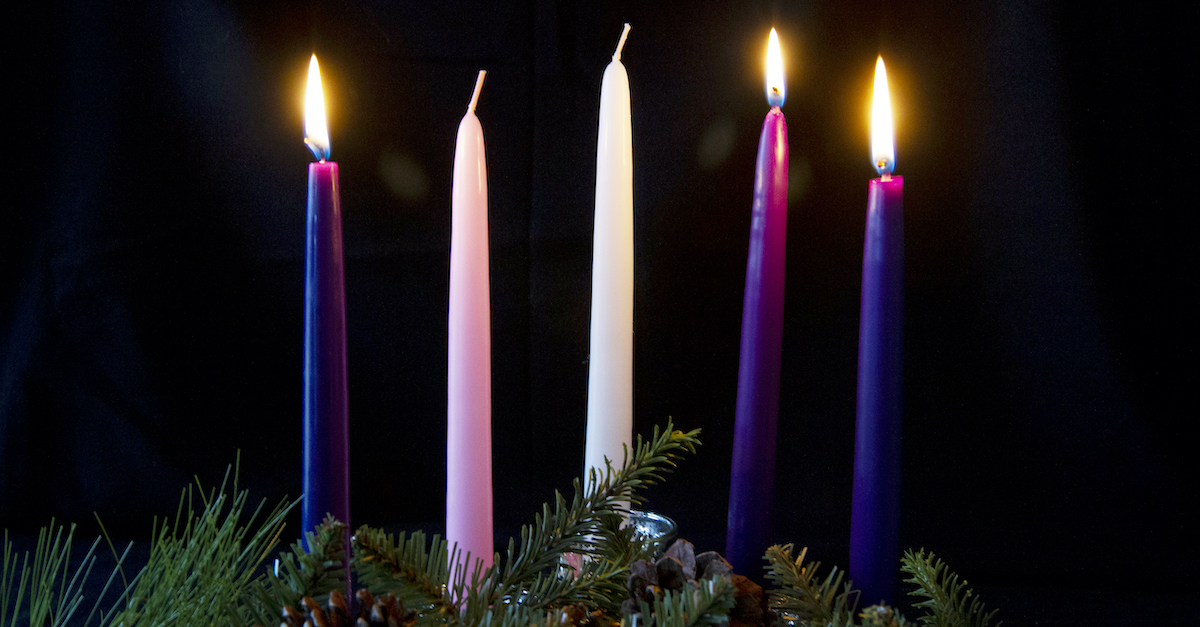
The waning of the year is a natural point to pause and recenter our lives on the longing for his appearing. As the light fades (some of us feel this physically in our bodies) we are naturally reminded that history has an end point. We also become acutely aware of the eschatological principle of the already/not yet. Increased darkness leads to watchfulness; this was especially so in humanity’s pre-industrial eras. The lighting of candles and the longing for dawn is a natural response this time of year. This is reflected in Advent’s focus on our longing for his appearing, especially the placement of Matthew 11 in the second Sunday of Advent. In this text, John the Baptist is rotting in prison and in his misery he sends messages to Jesus asking, “Are you the one who is to come, or shall we seek another?” What a profoundly honest question to ask in a time of darkness! That has to be the theme of our Advent expectancy!
Christ’s response to John does not berate him or cast him away. Instead, he castigates those who think that a man of faith like John should never doubt. His answer to John focuses on the concrete events of Christ’s life that show he is the fulfillment of prophecy, that he, in fact, is the One.
This is the movement of Advent. It begins with the promise of his return to set all things to right. Then it moves to the response of faithful believers in the midst of a very broken world, “Are you really the one?” or, “Are you ever going to deliver us?” Then we move in week three to the triumphant John, preaching repentance ahead of the judgment of the Lord. Finally, we have the announcement by the Angel of the one to be born who will set his people free.
That’s Advent! It’s not what our culture has made it to be, and frankly many people have grown to hate. Advent, in its design, is a season to reset ourselves and to renew our joy in the midst of a dark season. This is why the liturgy for the third Sunday in Advent begins with these words, “Rejoice in the Lord always. I will say it again, Rejoice!” This is the hinge on which the Advent season turns.
Gaudete! Y’all rejoice! Not out of a naïve sentimentality or due to a blind consumeristic obsession, but because though we’ve been honest and realistic about the brokenness of our world, we’ve found again a reason to hope!
I wonder if that Washington Post author would still hate Christmas if the church still led in observing Advent in this way? I wonder if folks would still long for January 1 when it will all be over, if we still kept the distinction between Advent and Christmas? We in the USA talk about there being a war on Christmas in our culture. But what if I told you that many European believers think that it is America that is truly waging the war on Christmas? As the observance of Santa Claus circles the globe haven’t even we in the church lost sight of what Advent and Christmas were originally designed to be?
One more time, Advent is not Christmas.
Visit New Life Presbyterian Church for more articles and teaching from Tim LeCroy. New Life is a church worshiping in the beautiful Finger Lakes region of New York serving both the Cornell University and Ithaca College communities.

 Vita pastoralis